TikTok Hook Ideas: 50 Opening Lines That Stop the Scroll
Estimated reading time: 14 minutes
Why the First 3 Seconds Decide Everything
TikTok’s algorithm does not care how long you spent editing your video. It does not reward production value, follower count, or posting consistency on its own. What it rewards is watch time, and watch time starts — or dies — in the first three seconds.
This is not a theory. TikTok’s own creator documentation confirms that the platform measures completion rate and replay rate as core signals that push content to the For You Page. If viewers scroll past your video before the third second, that watch data tanks your distribution before the content even begins.
Here is what makes that statistic brutal: according to Microsoft research on digital attention spans, human attention in digital environments has grown dramatically shorter over the past decade, with initial content judgment happening almost instantaneously. On a platform like TikTok, where infinite scrollable content sits one thumb-swipe away, your opening line is not just important — it is the entire ballgame.
The creators who consistently hit the For You Page are not necessarily the most talented videographers or the wittiest personalities. They are the ones who have mastered TikTok opening lines that create an immediate psychological pull. They understand pattern interrupts, open loops, and curiosity gaps in a way that most casual creators never explore.
This guide breaks all of that down into something actionable. You will get 50 scroll-stopping hook ideas you can use today, the frameworks behind why each one works, and a clear understanding of how to match your hook style to your specific audience and niche.
The Anatomy of a Great TikTok Hook
Before diving into examples, it is worth understanding what separates a great hook from a forgettable one. A high-performing hook does three things simultaneously.
It creates a pattern interrupt. The human brain is wired to ignore the familiar and snap to attention when something unexpected appears. A pattern interrupt breaks the monotony of a scrolling feed — whether through a bold statement, an unusual visual, an unexpected sound, or a question that disrupts assumptions.
It opens a loop. Psychological research on the Zeigarnik Effect, first documented by Soviet psychologist Bluma Zeigarnik, shows that humans remember and fixate on incomplete tasks far more intensely than completed ones. A great hook opens a mental loop — it promises a payoff that the viewer has not yet received, making them stay to close the loop.
It speaks directly to a specific person. Generic hooks appeal to everyone and therefore resonate with no one. The most effective TikTok attention grabbers are hyper-specific. “If you run a Shopify store and your conversion rate is under 2%..” immediately filters an audience and makes the right viewer feel like the content was made exclusively for them.
When these three elements align in your opening line, retention follows naturally.
The 8 Core Hook Frameworks
Think of these frameworks as the engine types behind every effective TikTok script starter. The 50 examples later in this guide each plug into one of these structures.
| Hook Framework | Psychological Trigger | Best Used For |
|---|---|---|
| Shocking Statement | Cognitive dissonance | Education, myth-busting, news |
| Curiosity Gap | Open loop / Zeigarnik Effect | Tutorials, storytelling, reveals |
| Bold Claim | Status and authority | Business, fitness, finance, life advice |
| Relatable Opener | Identification and social proof | Lifestyle, humor, niche communities |
| Question Hook | Direct engagement | Any niche with a defined pain point |
| Storytelling Hook | Narrative tension | Personal brand, entertainment, case studies |
| Fear or Urgency | Loss aversion | Finance, health, time-sensitive content |
| Visual Hook | First frame rule | Product demos, transformations, aesthetic niches |
Each of these frameworks taps into a different area of decision-making. The best creators rotate between them depending on the content type, keeping their audience from becoming desensitized to any single approach.
50 TikTok Hook Ideas by Category
Shocking Statement Hooks (1–8)
These video hook examples lead with a statement so counter-intuitive or surprising that the viewer cannot scroll without knowing more.
- “Everything you were taught about [topic] is factually wrong”
- “I made $14,000 in one week doing something most people consider a hobby”
- “The [industry] industry does not want you to know this exists”
- “Most doctors will never tell you this about [health topic]”
- “I quit my six-figure job and tripled my income. Here is exactly what happened”
- “Your [common product] is probably hurting you, and here is the proof”
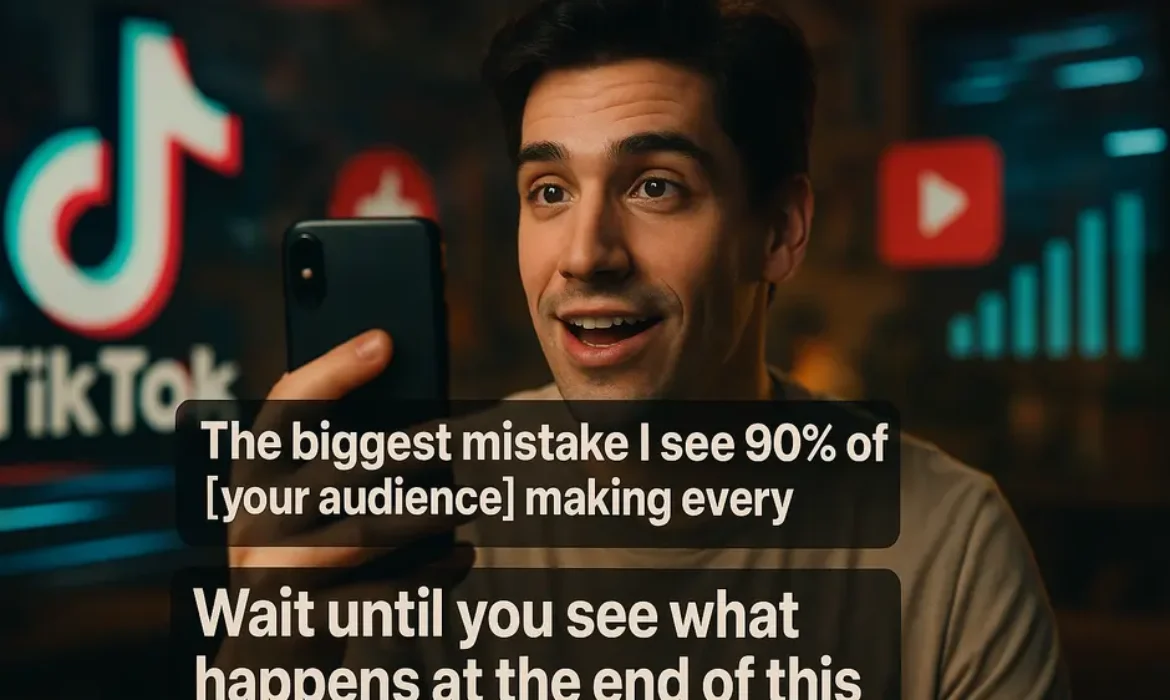
- “The biggest mistake I see 90% of [your audience] making every single day”
- “This one thing is silently draining your [energy / money / time]”
Why they work: These hooks create immediate cognitive dissonance. The viewer’s brain is presented with information that conflicts with their existing belief system. That friction generates curiosity and stalls the scroll instinct.
Curiosity Gap Hooks (9–16)
These TikTok hook ideas deliberately withhold the most compelling piece of information, forcing the viewer to stay for the answer.
- “Wait until you see what happens at the end of this”
- “I tried [method] for 30 days. The results were not what I expected”
- “There is a reason successful people do this every morning, and it is not what you think”
- “Part 3 of the story that broke the internet. You need the context first”
- “The thing I found out last Tuesday changed how I run my entire business”
- “Nobody talks about the second step. That is where everything changes”
- “I almost did not post this”
- “What happened next is the part everyone gets wrong”
Why they work: The curiosity gap, a concept popularized in academic research by Carnegie Mellon professor George Loewenstein, explains that humans feel genuine discomfort when they sense a gap between what they know and what they could know. These hooks manufacture that gap deliberately.
Bold Claim Hooks (17–23)
These open with a confident, declarative statement that signals the creator has earned-authority insight to share.
- “This is the only [topic] framework you will ever need”
- “I have tested 47 different [strategies]. Only one actually works consistently”
- “Stop overcomplicating [topic]. It is this simple”
- “The fastest way to [desired result] is not what any guru is telling you”
- “After [X years] in [industry], here is the truth nobody publishes”
- “You do not need [expensive thing]. You need this instead”
- “This single habit is responsible for 80% of my [results]”
Why they work: Bold claims signal confidence and expertise simultaneously. According to research published by Nielsen Norman Group on trust and credibility in digital content, users give more attention to content that leads with specific, confident claims rather than hedged or vague openers.
Relatable Opener Hooks (24–30)
Relatable hooks build instant identification. The viewer sees themselves in the first line and feels the video is speaking directly to their reality.
- “If you have ever stayed up until 3am overthinking [situation], this is for you”
- “Nobody told me [truth about life, career, money] when I was starting out”
- “I used to be the person who [relatable negative habit]. Then I figured this out”
- “This is what no one tells you about [milestone everyone aspires to]”
- “POV: You are trying to [common goal] on a tight budget”
- “Every [your target audience] needs to hear this”
- “If [specific situation] sounds familiar, you are not the only one”
Why they work: Mirror neurons and social identification make humans instinctively lean into content that reflects their own experience. The moment a viewer thinks “that is me,” the hook has done its job.
Question Hooks (31–36)
A well-crafted question forces the brain to begin formulating an answer, which generates engagement before a single piece of advice has been delivered.
- “What would you do if you found out [surprising situation]?”
- “Have you ever wondered why [counterintuitive phenomenon] happens?”
- “What is the one thing holding you back from [desired outcome]?”
- “Why do [professionals] all do this but nobody talks about it?”
- “Are you making this mistake with your [daily habit / tool / strategy]?”
- “What does [successful person] do differently that nobody copies?”
Why they work: Questions activate what cognitive scientists call “instinctive elaboration” — the brain cannot receive a question without starting to process a response. That processing state is incompatible with scrolling away.
Storytelling Hooks (37–42)
Storytelling hooks drop the viewer directly into the middle of a narrative. No preamble, no context — just the action.
- “Three years ago, I was living in my car. Last month, I closed a $200,000 deal”
- “My client was about to give up. Then this happened on a Tuesday afternoon”
- “I sent one cold email. What happened over the next 72 hours changed everything”
- “The call I got at 11pm last October completely restructured how I think about [topic]”
- “I almost made the worst decision of my career. Here is what stopped me”
- “Day one of [challenge / experiment]. I had no idea what I was about to learn”
Why they work: Narrative transportation theory, explored extensively by researchers including Melanie Green and Timothy Brock, demonstrates that story-based content overrides analytical skepticism and creates genuine emotional investment.
Fear or Urgency Hooks (43–47)
These hooks activate loss aversion — one of the most powerful motivational forces in human psychology, identified by Daniel Kahneman and Amos Tversky in their foundational work on Prospect Theory.
- “If you are still doing [common practice], stop immediately”
- “The window for [opportunity] is closing faster than anyone realizes”
- “You are losing money every single day you ignore this”
- “This mistake is costing [your audience] thousands without them knowing it”
- “By the time most people figure this out, it is too late”
Why they work: Humans are psychologically more motivated by the fear of loss than the prospect of gain. These hooks signal that inaction carries a cost, which creates urgency far more effectively than positive framing alone.
Visual Hooks (48–50)
These are hooks where the first frame itself does the heavy lifting — they are built for silent viewers who have not yet turned on sound.
- Show the dramatic end result of a transformation in the first frame, then rewind. No words needed
- Hold a physical object, product, or tool to camera with bold text overlaid: “This thing changed my [area of life]”
- Begin mid-action — hands working, something being built or revealed — with text asking “Can you guess what this becomes?”
Why they work: According to TikTok’s own creator insights documentation, a significant percentage of TikTok videos are watched without sound. A compelling visual hook captures both sound-on and sound-off viewers simultaneously.
How to Match Your Hook to Your Niche
Not every hook framework works equally well across every category. Here is a practical matching guide.
| Niche | Best Hook Types | Why |
|---|---|---|
| Personal Finance | Bold Claim, Fear/Urgency, Shocking Statement | Audience is motivated by fear of loss and desire for financial clarity |
| Fitness & Health | Relatable Opener, Shocking Statement, Question | Viewers identify with struggle and want debunked myths |
| Business & Entrepreneurship | Storytelling, Bold Claim, Curiosity Gap | Social proof and authority drive trust; aspiration drives retention |
| Beauty & Fashion | Visual Hook, Relatable Opener | High visual category; first frame and identification are paramount |
| Food & Cooking | Visual Hook, Question | The result is the hook — show it immediately |
| Education & Tutorials | Curiosity Gap, Bold Claim | Withholding the method creates the compulsion to watch |
| Mental Health & Lifestyle | Relatable Opener, Storytelling | Vulnerability and identification are the primary engagement drivers |
| Comedy & Entertainment | Pattern Interrupt, Relatable Opener | Subverting expectations is the mechanism; relatability seals retention |
The First Frame Rule: Visual Hooks That Work Without Sound
The first frame rule is straightforward: assume your first frame will be seen as a static image before the viewer decides whether to play your video. That frame needs to communicate value, tension, or intrigue on its own.
Practically, this means several things.
Your face or subject should fill the frame. Wide, impersonal shots do not create connection. Close proximity creates immediate intimacy and focus.
Text overlay should appear within the first half-second. Waiting until second two to introduce your caption text is waiting too long. Viewers who have not turned on audio need a reason to tap the sound on within the first frame.
Never start with a black screen, a logo card, or a slow pan. These are conversion killers. They signal to the algorithm and to the viewer that the creator prioritized aesthetics over the viewer’s time.
The contrast between your background and your text needs to be sharp. Readability on a small mobile screen in various lighting conditions is a real-world consideration that many creators overlook entirely.
Common Hook Mistakes Killing Your Retention
Even experienced creators fall into these patterns. Recognizing them is the first step to correcting them.
Starting with “So..” or “Hey guys.” These phrases have become the audio equivalent of a loading screen. They signal nothing and create no tension. Begin your video at the point where something is already happening.
Burying the hook. The hook is not your third sentence after you have explained who you are and what the video is about. The hook is the first thing out of your mouth or the first thing visible on screen.
Being vague to seem mysterious. There is a meaningful difference between a genuine curiosity gap and a hook that is simply confusing. “I learned something interesting” is not a curiosity gap. “The reason your savings account is actually costing you money” is.
Overpromising without delivering. A hook is a contract with the viewer. If your opening promises a revelation and your video delivers a meandering ramble, your completion rate collapses and your account’s algorithmic authority drops with it.
Using the same hook structure repeatedly. Your existing audience will clock your formula and tune out. Rotate between frameworks to maintain genuine novelty.
Key Takeaways
-
- TikTok’s algorithm rewards watch time. Your hook determines whether that watch time is captured or lost within three seconds
- There are eight core hook frameworks: Shocking Statement, Curiosity Gap, Bold Claim, Relatable Opener, Question, Storytelling, Fear/Urgency, and Visual Hook
- The curiosity gap and open loop principle are among the most psychologically powerful tools in video scripting — use them deliberately and close the loop with genuine value
- Match your hook style to your niche. A fear/urgency hook that performs brilliantly in personal finance will feel out of place in a food content account
- The first frame rule applies to every video. Assume your thumbnail must communicate something compelling before a single second of video plays
- Avoid generic openers like “Hey guys” or “So today I wanted to talk about” — these are retention killers dressed as friendliness
- Rotate your hook frameworks to prevent audience desensitization
- A hook is a promise. Your video content must deliver on it
FAQs
Q1: How long should a TikTok hook actually be?
The most effective hooks land their central tension within the first two to three seconds. That translates to roughly one to two sentences of spoken content, or a single strong visual paired with on-screen text. Some hooks work in a single sentence. The measure of a hook’s length is not word count — it is how quickly it creates a reason to keep watching. If your opening line requires a second sentence to get interesting, your first sentence needs reworking.
Q2: Do TikTok hooks work the same way on Instagram Reels and YouTube Shorts?
The underlying psychology is identical across all short-form video platforms because it is rooted in human attention behavior, not platform mechanics. However, the specific execution varies. On Instagram Reels, aesthetic quality and visual hooks carry slightly more weight given Instagram’s heritage as a visual platform. On YouTube Shorts, the audience may have slightly longer patience for context before the payoff because YouTube’s broader user base includes more long-form content consumers. The core frameworks — curiosity gap, open loop, pattern interrupt — transfer completely.
Q3: Is it manipulative to use psychological hook techniques?
This concern comes up frequently and deserves a straightforward answer. Every form of effective communication uses psychology — from book covers to news headlines to the layout of a supermarket. The ethical distinction lies in what the hook leads to. A hook that opens a loop and then delivers genuine, useful content is a service to the viewer. A hook that manufactures false urgency, misleads about the content of the video, or baits viewers into watching something entirely different is a legitimate issue — and TikTok’s own community guidelines address misleading content directly. The technique itself is neutral. The intent and delivery determine the ethics.
Q4: Can I use the same hook for multiple videos?
A hook framework can absolutely be reused. The specific wording, however, should be refreshed regularly. If your audience recognizes your hook structure before you have finished the first sentence, the pattern interrupt effect disappears entirely — and the pattern interrupt is often what makes the hook work. Think of frameworks as templates and specific lines as content that should rotate with each video. Additionally, TikTok’s algorithm itself can penalize perceived repetition in content structure over time, making fresh variation a technical priority as well as a creative one.
Q5: What is the difference between a hook and a thumbnail?
These two elements work in concert but serve distinct functions. A thumbnail (or cover image) is the static image that appears before a viewer decides to play a video. Its job is to prompt the tap. The hook is the spoken or on-screen content within the video’s first two to three seconds. Its job is to prevent the viewer from scrolling after tapping. Both are essential, and both need to work together — a great thumbnail that sets an expectation which the hook then abandons immediately will still result in high drop-off. Continuity between your cover and your opening moment is a detail that separates professional creators from amateurs.
Q6: How do I write a hook if my content is educational and I do not have a dramatic story?
Educational content is particularly well-suited to curiosity gap and bold claim hooks. You do not need a personal story to create tension — you need to withhold the most valuable piece of information until after the hook has done its work. For example, rather than opening with “Today I am going to explain how compound interest works,” you open with “The reason most people never build real wealth has nothing to do with income — and I can show you the math in under two minutes.” The same information, the same video, but the second version creates forward momentum. The curiosity gap is built from the information asymmetry between what the viewer knows and what you are about to show them.
Q7: How many hooks should I test before deciding what works for my account?
Test at minimum three to five distinct hook frameworks per content theme before drawing conclusions. TikTok’s organic distribution means that some videos take 24 to 72 hours to reach their full distribution, so patience in the analysis phase is essential. When reviewing performance, look at average watch time and completion rate in your TikTok Analytics rather than likes alone — a video with modest likes but high completion rate is algorithmically healthy and worth studying for its hook structure. Over time, you will identify which frameworks generate the strongest early retention for your specific audience, while continuing to rotate to prevent formula fatigue.
Conclusion
The scroll is relentless, and attention is genuinely scarce. But the creators who understand that a TikTok video lives or dies in its opening three seconds have a structural advantage that has nothing to do with budget, equipment, or follower count.
Every hook idea in this guide is grounded in real psychological mechanisms — pattern interruption, open loops, loss aversion, narrative tension, and social identification. These are not tricks. They are a recognition of how human attention actually operates in high-volume content environments.
Start by picking two or three frameworks from this guide that align naturally with your content style and niche. Test them with intentionality. Study your watch time data. Iterate on what the numbers tell you rather than what your instinct assumes. Over time, crafting a scroll-stopping opening line becomes less about searching for the perfect hook and more about understanding your audience deeply enough to know exactly what makes them stop.
That understanding is what separates creators with growing, engaged audiences from those who post into the void wondering why nothing sticks.
Sources and further reading: TikTok Creator Portal | Nielsen Norman Group on Digital Credibility | Loewenstein, G. (1994). The psychology of curiosity. Psychological Bulletin. | Kahneman, D. & Tversky, A. (1979). Prospect Theory. Econometrica.