Short-Form Video Strategy: How to Build an Audience on TikTok, Reels & YouTube Shorts (2026)
Estimated reading time: 14 minutes
Key Takeaways
-
- A winning short-form video strategy starts with defined content pillars, not random posting
- The first three seconds of your video determine whether your audience stays or scrolls
- Each platform has a distinct algorithm, audience behavior, and content culture — treat them differently
- Trending audio increases your content’s discoverability, especially on TikTok and Reels
- Posting consistency matters more than posting frequency — sustainable schedules outperform burst-and-burnout approaches
- Engagement rate, watch time, and saves are the metrics that signal real audience growth
- Repurposing works, but native optimization for each platform is non-negotiable
Why Short-Form Video Is the Most Powerful Growth Channel Right Now
The numbers are no longer surprising — they are just undeniable. Short-form video now accounts for over 60% of all online video consumption globally, according to Statista’s Digital Media Outlook. TikTok crossed 1.7 billion monthly active users heading into 2025. Instagram Reels drives more than 30% of time spent on the platform. YouTube Shorts crossed 70 billion daily views in 2024 and continues to climb.
But here is what most creators and marketers still miss: the opportunity is not just the volume. It is the discoverability. Unlike most social formats, short-form video is one of the few places where a brand new account can reach hundreds of thousands of people organically — without paid ads, without an existing following, and without industry connections. That is a rare and genuinely powerful distribution advantage.
The challenge, of course, is that every brand, creator, and business has figured this out by now. The feed is competitive. Attention is fragmented. And vague advice like “just post more” has never been less useful. What actually builds an audience in 2026 is a deliberate, platform-intelligent short-form video strategy that respects how each app works, what each audience wants, and how sustainable creative output actually functions.
This guide breaks all of that down — platform by platform, tactic by tactic.
Understanding the Three Platforms: Key Differences You Cannot Ignore
A common mistake is treating TikTok, Instagram Reels, and YouTube Shorts as identical containers for the same content. They are not. Each platform has a distinct culture, a different algorithmic priority, and a different audience mindset when they open the app.
| Platform | Primary Discovery Mechanism | Typical Audience Mindset | Best Content Length | Key Strength |
|---|---|---|---|---|
| TikTok | For You Page (FYP) — interest-based | Entertainment-first, discovery mode | 15–60 seconds (up to 3 min for serialized) | Organic reach for new accounts |
| Instagram Reels | Explore + Reels tab + follower feed | Social validation, aesthetics, trends | 7–30 seconds | Cross-promotion with existing following |
| YouTube Shorts | Shorts shelf + Search integration | Problem-solving, education, entertainment | 30–60 seconds | Long-term search discoverability |
TikTok is fundamentally a discovery engine. Its algorithm is interest-based rather than social-graph-based, which means your content can reach people who have never heard of you and have no connection to your existing followers. This makes it the most powerful cold-audience acquisition tool of the three. The culture rewards authenticity, humor, and trends — polished corporate content tends to underperform.
Instagram Reels operates within a hybrid system. It surfaces content to non-followers through the Explore page and the Reels tab, but it also rewards accounts that already have engaged followers. The aesthetic bar on Instagram is generally higher, and Reels benefit enormously from cross-pollination with Stories and the main feed. It is an excellent platform for converting viewers into followers who will engage across your broader Instagram presence.
YouTube Shorts is the sleeper powerhouse that many creators underestimate. Because it sits within YouTube’s ecosystem — the world’s second largest search engine — Shorts have a longevity advantage the other two platforms lack. A Short about a specific topic can continue surfacing in search results for months. It also acts as a funnel into your long-form content library, making it particularly valuable for educational creators, coaches, and businesses.
Understanding these differences is not optional — it is the foundation of any intelligent short video marketing plan.
Building Your Content Pillars Before You Film a Single Second
The creators who burn out within three months all have one thing in common: they start filming before they have a strategy. They chase whatever performed last week, copy trending formats without thinking about relevance, and produce a disjointed body of work that audiences cannot easily categorize or follow.
Content pillars solve this. A content pillar is a defined thematic territory your account owns. It answers the question: “What do people follow me for?” Most successful short-form accounts operate on three to five pillars, each serving a different purpose.
A practical pillar structure might look like this:
-
-
- Education/Value pillar — Tips, how-tos, and expertise that make viewers smarter or better at something
- Entertainment/Personality pillar — Content that showcases voice, humor, or relatability
- Social proof/Results pillar — Case studies, testimonials, or before-and-afters that build credibility
- Community/Conversation pillar — Response videos, polls, and content that invites dialogue
- Trend participation pillar — Strategic use of trending formats or audio to expand reach
-
Pillar-based thinking does two things simultaneously. First, it keeps your creative output focused and efficient — when you sit down to batch-create content, you are never staring at a blank screen wondering what to make. Second, it trains the algorithm to understand who to show your content to, which directly improves distribution.
A fitness coach, for example, might build pillars around quick workout demonstrations, nutrition myth-busting, client transformation stories, Q&A responses to common questions, and participation in trending fitness challenges. Every video fits somewhere. Every video serves a purpose.
The Hook Formula: Capturing Attention in the First 3 Seconds
Scroll velocity on short-form platforms is brutal. Viewers make the decision to keep watching or swipe within two to three seconds. This is not hyperbole — it is measurable data that every platform’s internal analytics confirms. Your hook is not a nice-to-have. It is the entire game.
A strong hook operates on one of several psychological triggers:
Curiosity gap — Tease information without fully delivering it. “The reason most people never grow on TikTok has nothing to do with how often you post.”
Bold claim — Lead with a counterintuitive or surprising statement. “Everything you’ve heard about posting time is wrong.”
Immediate visual action — Skip the intro entirely and start mid-action, forcing the viewer to orient themselves while watching.
Direct address — Speak to a specific person. “If you’re a freelancer struggling to get clients, stay with me for 30 seconds.”
Problem identification — Name a pain point the audience recognizes instantly. “You’re losing followers every week and you don’t even know why.”
The critical rule is that your hook must be completed by what follows. A curiosity gap hook that never delivers the payoff destroys trust and tanks watch time. Viewers who feel baited — without the promised value — will not return.
Beyond the first line, your visual hook matters equally. The first frame of your video should be arresting, not a black screen, not a slow pan, and definitely not a logo animation. Consider leading with text overlays, an unexpected visual, or a compelling facial expression that signals “this is worth watching.”
Posting Frequency, Timing, and Consistency
The most common question creators ask is how often they should post. The honest answer: as often as you can maintain quality without burning out — and not one video more.
The platforms do reward consistent posting. TikTok’s internal documentation has historically suggested a cadence of one to four videos per day for accounts in growth mode, but this advice was designed for teams, not solo creators. For individuals and small teams, three to five high-quality videos per week is a far more sustainable and effective approach than daily posting done poorly.
Platform-specific posting guidance:
| Platform | Recommended Frequency | Best Posting Windows (General) |
|---|---|---|
| TikTok | 3–5x per week minimum | 7–9am, 12–2pm, 7–11pm (audience’s local time) |
| Instagram Reels | 4–7x per week | 9–11am, 12–2pm, 5–7pm |
| YouTube Shorts | 3–5x per week | 12–3pm, 5–8pm |
A note on timing: while these windows are based on aggregated engagement data, they are less important than understanding when your specific audience is active. Every account’s analytics tell a different story. After four to six weeks of consistent posting, your platform analytics will reveal your audience’s actual peak activity hours — use those numbers, not generic advice.
Batch creation is the single most practical solution to consistency. Set aside one day per week or per fortnight to film everything, and schedule it out across the coming days. This separates the creative act from the distribution act, which reduces decision fatigue enormously.
How the Algorithms Actually Work in 2026
Every short-form platform uses machine learning to decide which content to amplify and which to suppress. While none of them publish full documentation, what we know from public statements, patent filings, and observable behavioral data paints a fairly clear picture.
TikTok’s algorithm distributes content in progressive test pools. A new video is first shown to a small audience — perhaps a few hundred viewers. The algorithm measures completion rate, share rate, comment rate, and re-watch rate. If those signals are strong, the video is pushed to a larger pool. This process repeats until the video either finds its ceiling or goes viral. The implication: a single high-performing video can put a brand new account in front of millions of people.
Instagram’s algorithm for Reels weighs a combination of content quality signals (clarity, audio quality, absence of watermarks — yes, TikTok watermarks are actively penalized by Meta), engagement velocity, and account relationship history. Instagram also favors Reels that encourage shares to Stories, which amplifies organic distribution.
YouTube Shorts’ algorithm combines YouTube’s traditional search-matching capabilities with behavioral signals similar to TikTok’s. Completion rate and the click-through rate from the Shorts shelf are particularly strong ranking factors. YouTube also looks at whether Shorts viewers migrate to your longer content, which feeds into overall channel health metrics.
The common thread across all three: watch time and completion rate are the most important signals you can influence. A video that keeps people watching until the end — or that earns re-watches — will be amplified. A video that prompts immediate swipes will be suppressed, regardless of how many followers you have.
Trending Audio and the Viral Amplification Effect
Sound is not decorative in short-form video — it is structural. On TikTok especially, trending audio functions as a discovery vehicle. When you use a sound that is actively trending, your video appears on the sound’s dedicated page, exposing you to everyone who searches or browses that audio track. This is a legitimate and significant organic reach mechanism.
The strategy is not to use any trending sound regardless of fit. It is to identify sounds that are trending within your niche or adjacent content categories, and find a creative way to make them relevant to your message. The best executions feel intentional rather than forced.
TikTok’s Creative Center provides real-time data on trending sounds, hashtags, and content categories — it is one of the most underused free research tools available to creators.
On Instagram Reels, trending audio works similarly, though Meta’s ecosystem has the added advantage of music licensing agreements that TikTok sometimes lacks. Reels also allow original audio to trend independently, which means a sound you create can become its own discovery vehicle if it gets picked up by other creators.
YouTube Shorts supports music through YouTube’s licensed music library, but the platform’s algorithm does not amplify audio in the same way as TikTok. Sound on Shorts matters primarily for viewer experience rather than discovery.
Practical audio strategy:
-
-
- Check trending sounds three to four times per week
- Save sounds you want to use before they peak — early adoption gets more algorithmic lift
- For YouTube Shorts, prioritize clear speech and strong narrative over music-driven content
- Always ensure audio fits your brand voice — using a comedic sound for a serious subject confuses your audience positioning
-
Calls to Action That Convert Viewers Into Followers
Views are vanity if they do not convert into followers, and followers are vanity if they do not convert into a community that takes action. The call to action (CTA) is where your short-form content strategy crosses over into actual audience-building.
The mistake most creators make is treating the CTA as an afterthought — a generic “follow me for more” tacked onto the end of the video. Effective CTAs are integrated into the content architecture, not bolted on.
High-converting CTA frameworks:
The serialized hook — End your video with a direct setup for the next piece of content. “Part two drops tomorrow — follow so you don’t miss it.” This works because it creates a reason to follow rather than just asking.
The save-bait value CTA — “Save this so you can come back to it.” Saves are among the highest-value signals on both TikTok and Instagram because they indicate that the viewer found the content genuinely useful. This CTA also trains your audience to interact with your content differently.
The comment-prompt CTA — Ask a specific, answerable question that invites debate or personal response. “Tell me in the comments — do you prefer posting in the morning or at night?” Vague CTAs like “let me know what you think” generate fewer responses than specific prompts.
The redirect CTA — For accounts using short-form video as a funnel, the bio link redirect is essential. “The full breakdown is linked in my bio” works on YouTube Shorts where you can directly link. On TikTok and Instagram, the link-in-bio mechanism is the primary redirect tool.
Place CTAs mid-video when possible, not just at the end. Completion rates mean a significant portion of your audience is already gone by the time your closing CTA appears.
Repurposing Content Across All Three Platforms Without Looking Lazy
Cross-posting the same video to all three platforms without modification is a shortcut that costs you more than it saves. Instagram penalizes TikTok watermarks. TikTok’s culture is different enough from YouTube’s that the same video can feel tone-deaf. And audiences who follow you on multiple platforms will notice — and resent — seeing the exact same content everywhere.
Smart repurposing means adapting the core idea, not duplicating the final product.
A practical repurposing workflow:
-
-
- Identify your highest-performing ideas — before repurposing, determine which concepts or topics are resonating most
- Create a native version for each platform — same topic, different execution based on platform culture and format requirements
- Adjust captions and text overlays — what reads as natural on TikTok can feel out of place on YouTube Shorts
- Remove watermarks — use a tool like CapCut or InShot to export clean versions of each video
- Modify CTAs for each platform’s mechanics — YouTube Shorts can link directly; TikTok and Instagram need bio-link redirects
-
The time investment of creating platform-native content pays off substantially in reach and engagement compared to direct cross-posting. Think of repurposing not as copying but as translation.
Measuring What Actually Matters: Metrics and Benchmarks
Follower count is the least useful metric for evaluating short-form video performance. It is a lagging indicator — a result of getting other things right, not a cause of growth. What you should actually be monitoring:
| Metric | What It Measures | Healthy Benchmark |
|---|---|---|
| Completion Rate | How many viewers watch to the end | 40%+ is strong; 25–40% is average |
| Watch Time | Total time spent watching your content | Growth trend matters more than absolute number |
| Engagement Rate | Likes, comments, shares, saves relative to views | 3–6% is solid; 6%+ is strong |
| Saves | Viewers bookmarking for later | High saves indicate high perceived value |
| Profile Visits | Views converting to profile curiosity | 5–10% of views visiting profile is a healthy ratio |
| Follower Conversion Rate | Profile visits converting to follows | 20–30% of profile visits converting is strong |
| Share Rate | Content being distributed by viewers | Shares are the most powerful growth signal |
Review these metrics weekly, not daily. Daily fluctuations create anxiety without producing actionable insight. Weekly trends reveal what is actually working.
FAQs
Q1: How long does it take to build an audience with a short-form video strategy?
There is no honest universal answer, but a realistic framework helps. Most accounts that post consistently — three to five times per week — and apply a deliberate strategy will see meaningful traction within 60 to 90 days. “Meaningful traction” means a growing engagement rate, occasional viral moments, and a follower count that reflects genuine audience interest rather than follow-for-follow activity. Accounts in high-competition niches may take longer. Accounts with genuinely differentiated perspectives and strong hooks can grow dramatically faster. The variable you control most is the quality of your hooks and the specificity of your content pillars.
Q2: Should I focus on one platform or post on all three simultaneously?
Start with one platform and master it before expanding. Trying to manage three platforms simultaneously from day one fractures your attention and degrades content quality. Choose based on where your target audience already spends time. If you are a B2C brand targeting under-35 consumers, TikTok is your starting point. If you are a business-to-business service provider or educator, YouTube Shorts — with its search integration — offers longer-term value. Once you have a repeatable content system on one platform, expanding to a second becomes manageable.
Q3: How important is video production quality for short-form content?
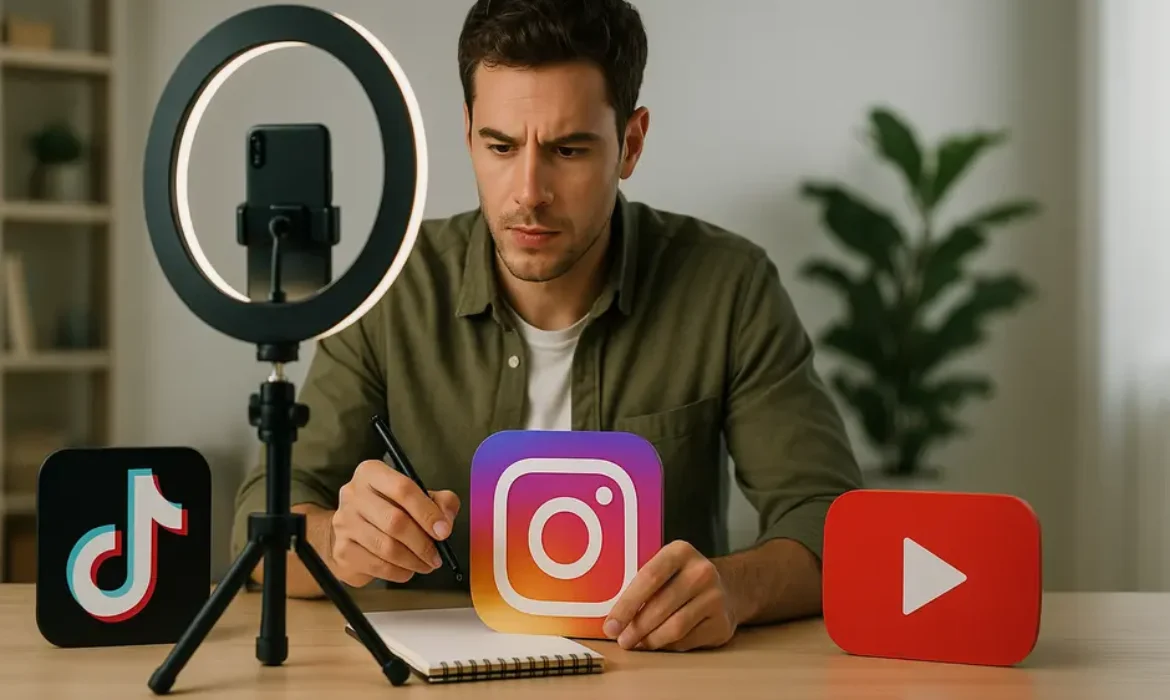
More important in 2026 than it was in 2021, but “production quality” does not mean expensive equipment. It means clear audio, adequate lighting, stable footage, and legible text overlays. Bad audio is the single biggest production problem that drives viewers away. A modern smartphone with a basic ring light and a $30 lapel microphone produces content that meets the platform standard. What platforms penalize is technically poor content — blurry, pixelated, or with distorted audio. They do not penalize content that looks authentic rather than cinematic.
Q4: Do hashtags still matter for short-form video discovery?
Hashtags have become significantly less influential as a primary discovery mechanism on TikTok and Instagram, both of which have moved toward interest-based and content-based algorithms rather than hashtag-matching. They still serve a secondary function — signaling content category to the algorithm — but using 20 hashtags will not save a video with poor watch time. Use three to five highly relevant hashtags per video, including one or two niche-specific tags and one or two broader category tags. On YouTube Shorts, hashtags in descriptions carry more weight for search discovery than on the other two platforms.
Q5: How do I handle slow growth periods without abandoning the strategy?
Plateaus are a normal part of the growth curve, not evidence that your strategy is broken. When growth slows, the most productive response is a content audit rather than a strategy pivot. Review your last 20 to 30 videos and identify the three to five that performed significantly above average. Look for patterns: topic type, hook format, posting time, video length, use of audio. Then produce more content that replicates those patterns intentionally. Abandoning a working content pillar because one week was slow is one of the most common — and most damaging — mistakes creators make.
Q6: Can short-form video work for B2B brands and professional services?
Absolutely, and it is still an underutilized channel in B2B. The key is recognizing that B2B buyers are also humans who use TikTok, Instagram, and YouTube outside of work hours. Short-form content for B2B works best when it educates rather than sells directly — breaking down industry concepts, sharing behind-the-scenes perspectives, or humanizing a brand that might otherwise feel faceless. LinkedIn has also entered the short video space aggressively, which adds a native B2B platform to the vertical video ecosystem. Firms like PwC and HubSpot have demonstrated that professional service content can perform well in short-form formats when the tone is calibrated correctly.
Q7: What is the biggest strategic mistake brands make with short-form video?
Treating short-form video as a miniaturized version of their existing advertising content. Short-form platforms are not TV channels. Audiences have zero obligation to watch, zero patience for slow buildups, and immediate access to a scroll that eliminates anything that feels like an interruption. The brands that succeed adapt their communication style to platform culture rather than importing their existing brand templates into a new container. This often means loosening brand guidelines around humor, informality, and production style — which requires internal organizational courage as much as creative skill.
Conclusion
Building an audience with short-form video in 2026 is simultaneously more competitive and more opportunity-rich than it has ever been. The competition is real — billions of videos are uploaded every day, and attention is a genuinely finite resource. But the platforms continue to prioritize organic discovery in ways that almost no other digital channel still does.
The creators and brands that win are not the ones who post the most or spend the most on production. They are the ones who understand their audience deeply enough to stop their scroll in the first three seconds, who are consistent enough to show up week after week, and who are strategic enough to adapt their approach based on what their analytics actually tell them.
A strong short-form video strategy is not complicated. Define your content pillars. Master your hook. Respect each platform’s culture. Stay consistent without burning out. Measure the right metrics. Improve iteratively.
Everything else — trending sounds, posting times, hashtag strategies — is optimization around that foundation. Get the foundation right first, and the optimization questions become much easier to answer.