
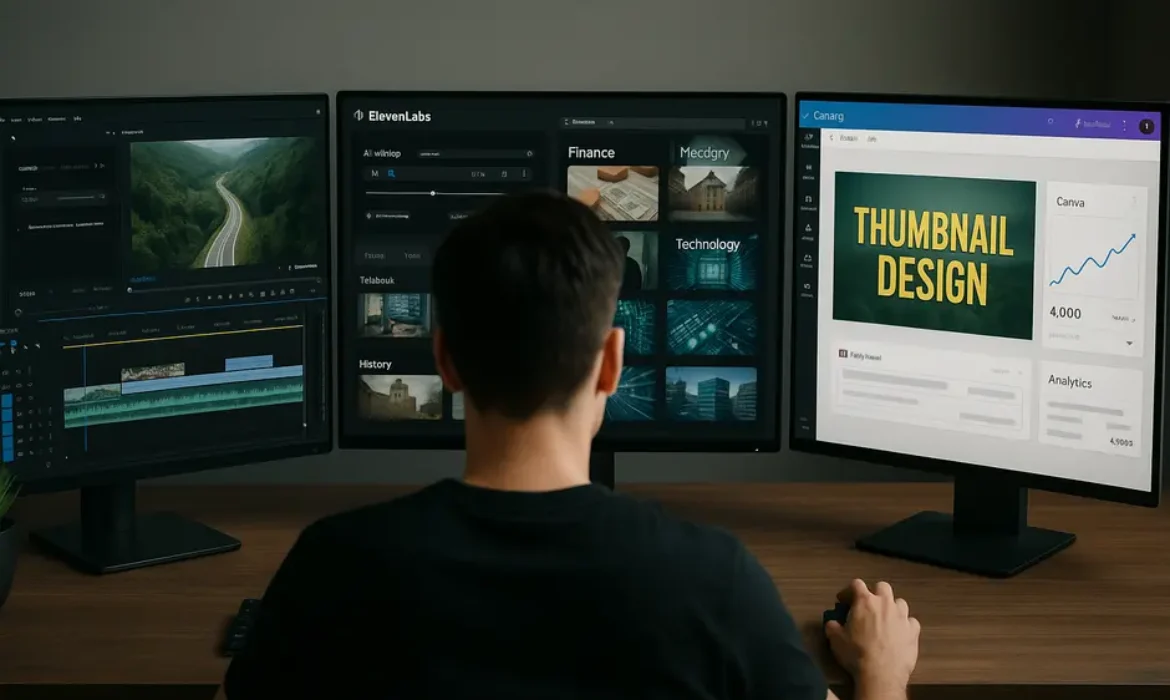
How to Start a Faceless YouTube Channel in 2026 (Step-by-Step)
Estimated reading time: 14 minutes
Key Takeaways
-
- Faceless YouTube channels let you build scalable content businesses without ever appearing on camera
- Niche selection is the single most important decision you will make, and it determines both your growth speed and monetization ceiling
- Tools like ElevenLabs, Canva, and royalty-free stock footage platforms have made production quality accessible to solo creators
- YouTube automation does not mean zero effort — it means systematizing your workflow so each video requires less of your personal time
- Channels in finance, history, true crime, and self-improvement consistently outperform in terms of CPM and audience loyalty
- Your first 10 videos teach you more than any course will — publish early, optimize often
Why Faceless YouTube Channels Are Booming in 2026
There is a quiet revolution happening on YouTube, and it has nothing to do with viral personalities or influencer drama. It is being driven by creators who have never shown their face on camera — not once — and are building audiences in the hundreds of thousands while generating serious income.
The numbers support this. YouTube reported over 2.7 billion logged-in monthly users heading into the mid-2020s, and content consumption has only accelerated. Meanwhile, a growing segment of that audience craves information-rich, calm, and focused content — exactly what faceless channels tend to deliver.
The appeal from the creator side is equally compelling. You can build and run a profitable YouTube channel without the anxiety of being on camera, without expensive camera gear, and increasingly, without recording your own voice. With advances in realistic AI voiceover technology and an abundance of high-quality stock footage, the barrier to entry has dropped dramatically.
But here is what most guides will not tell you: faceless channels are not easier to grow. They require a different set of skills — tighter scripting, stronger hooks, smarter niche positioning. The face-based creators rely on personality to carry momentum. Faceless creators rely almost entirely on content quality and structure. That is both the challenge and the opportunity.
What Exactly Is a Faceless YouTube Channel?
A faceless YouTube channel is any channel where the creator never appears on camera. Instead of on-screen presence, these channels typically use one or more of the following formats:
-
-
- Voiceover with stock footage or video clips — narrated explainers, documentary-style content, news commentary
- Screen recordings — tutorials, software walkthroughs, financial analysis
- Animated or motion graphics — whiteboard videos, text animations, explainer videos
- Text-on-screen with background music — popular in niche content like stoicism quotes, motivational content
- Slide-based presentations — common in educational and business content
-
Some creators record their own voice. Others use AI voiceover tools to generate narration entirely without human recording. Both approaches work — the right choice depends on your comfort level, production goals, and how much you want to systematize the operation.
The term “YouTube automation” often gets attached to faceless channels, which creates some confusion. Automation really refers to outsourcing or systematizing various parts of production — scriptwriting, voiceover, editing, thumbnails — so the channel can publish consistently without you doing everything manually. Plenty of faceless channels are not automated at all; one person handles everything. Others are essentially content businesses with a team of freelancers.
Choosing the Right Niche (The Decision That Changes Everything)
Niche selection is where most beginners either set themselves up for success or quietly doom themselves before publishing a single video. The niche determines your audience size, your CPM rate (how much advertisers pay per thousand views), your content difficulty, and your long-term monetization options.
Here is a practical framework for evaluating a niche:
The Four-Filter Niche Test
| Filter | Question to Ask | Why It Matters |
|---|---|---|
| Audience Demand | Are people actively searching for this content? | No demand means no organic discovery |
| CPM Potential | Do advertisers spend heavily in this category? | Higher CPM = more revenue per 1,000 views |
| Content Longevity | Will videos stay relevant for months or years? | Evergreen content compounds over time |
| Production Feasibility | Can you produce this without showing your face? | Some niches are harder to execute faceless |
High-Performing Niches for Faceless Channels in 2026
Personal Finance and Investing — CPMs in this niche frequently range between $15 and $40. Topics like index fund investing, budgeting strategies, and passive income ideas attract an educated, financially active audience that advertisers are willing to pay handsomely to reach.
History and True Crime — Narrative-driven content that works beautifully with stock footage and voiceover. Audiences in these categories binge heavily, which drives strong watch time metrics.
Health and Wellness — Sleep, nutrition, mental health, and longevity topics perform exceptionally well. CPMs are solid, and the audience is enormous.
Technology and AI Explainers — In a period of rapid technological change, there is insatiable demand for clear explanations of complex topics. This niche rewards well-researched, clearly produced content.
Self-Improvement and Psychology — Stoicism, productivity, habit building, and behavioral psychology channels have cultivated enormous subscriber bases with nothing but voiceover, text on screen, and ambient music.
Business and Entrepreneurship — Case studies, startup stories, and business strategy content attract a high-value audience with strong CPMs.
Avoid choosing a niche purely based on what is trending. Trends fade. Choose a niche where you have genuine curiosity or existing knowledge — that translates into better scripts, more accurate information, and content that does not feel generic.
Tools You Actually Need to Get Started
The tools available to faceless creators in 2026 are genuinely impressive. Here is a practical breakdown of what you need at different production stages.
Scripting
Good scripts are the backbone of any successful faceless channel. No tool replaces original research and clear thinking, but tools like Notion or Google Docs work fine for drafting. Some creators use Claude or similar writing assistants to accelerate research and outlining, but the final voice and angle should always be yours.
Voiceover
ElevenLabs has become the benchmark for AI voice generation. The platform produces voices with natural cadence, emotional range, and minimal robotic quality. For creators who do not want to record their own voice — or who want to maintain complete anonymity — ElevenLabs is currently the most production-ready option available. You can explore their voice library and pricing at elevenlabs.io.
If you do want to record your own voice, a USB condenser microphone like the Blue Yeti or Audio-Technica AT2020 will give you clean audio for under $100. Decent audio quality matters far more than video quality on faceless channels.
Visuals
Stock Footage: Platforms like Pexels, Pixabay, and Storyblocks give you access to royalty-free footage. Storyblocks operates on a subscription model that is well worth it if you are publishing regularly, since the library is substantially larger.
Canva: An essential tool for thumbnail creation and basic motion graphics. Canva Pro unlocks a range of features that meaningfully speed up the design process, particularly if you are handling everything yourself.
CapCut and DaVinci Resolve: Both are strong video editing options. CapCut is faster to learn and works well for straightforward stock footage videos. DaVinci Resolve is more powerful and completely free, making it the go-to for creators who want professional-grade editing without the software cost.
Thumbnail and SEO Research
vidIQ and TubeBuddy are the two dominant YouTube research and optimization platforms. Both offer keyword research, competitor analysis, and performance tracking. vidIQ has a slight edge for trend data; TubeBuddy is excellent for A/B testing thumbnails once your channel has enough traffic to make that data meaningful.
For broader keyword research that informs your content calendar, Google Trends and Ahrefs remain the most reliable tools available.
Step-by-Step: Building Your Faceless Channel From Scratch
Step 1: Define Your Channel Identity
Before you open YouTube Studio, spend genuine time on positioning. What is your channel about? Who is the specific person you are serving? What makes your take on this topic different or better than what already exists?
You do not need a radically original concept. You need a clearly defined angle. A finance channel for people in their 20s and 30s who grew up without financial education is more compelling than a generic “money tips” channel.
Create a simple channel brief: niche, target audience, content format, publishing frequency, and the one-line reason someone should subscribe.
Step 2: Set Up Your Channel Properly
Channel setup affects your first impression and your searchability. Use your primary keyword in the channel description. Write a compelling channel description that speaks directly to your target viewer — this is often where you earn the subscribe from someone who has just finished their first video.
Add channel art and a profile image. For a faceless channel, a clean logo or icon works well. Canva has channel art templates that take minutes to customize.
Step 3: Research and Script Your First Videos
Start with 5 to 10 video topics based on search demand, not just personal interest. Use vidIQ or TubeBuddy to find keywords with reasonable search volume and lower competition. Your goal early on is not to rank for the most competitive terms — it is to build a track record and learn what resonates.
Each script should follow a clear structure:
-
-
- Hook (first 30 seconds): State the core value of the video immediately. Answer the question: why should someone keep watching?
- Body: Deliver on the promise of the title and thumbnail in a logical, well-paced sequence
- Call to Action: One clear ask — subscribe, watch the next video, or leave a comment
-
Scripts for a 10-minute video typically run between 1,400 and 1,600 words when read at a natural pace.
Step 4: Produce Your Videos
Your production workflow should become a repeatable system. Here is a straightforward workflow that works for solo creators:
-
-
- Finalize the script
- Generate or record voiceover
- Source relevant stock footage or screen record your content
- Edit video in CapCut or DaVinci Resolve — sync footage to voiceover, add captions, background music at low volume
- Export and create thumbnail in Canva
-
For your first few videos, expect this to take 6 to 10 hours per video. With practice and a refined workflow, this drops significantly.
Step 5: Optimize for YouTube Search
YouTube is the world’s second-largest search engine. Every video upload is an SEO opportunity.
-
-
- Title: Lead with your target keyword, keep it under 60 characters, make it compelling
- Description: Write a real description — at least 200 words — that naturally includes your target keyword and related terms in the first two paragraphs
- Tags: Use 5 to 10 relevant tags that reflect the specific topic and broader category
- Chapters: Add timestamps for every section — this improves watch time and appears in Google search results
- Captions: Upload an accurate transcript. Auto-generated captions have improved but manual transcripts are indexed more reliably
-
Step 6: Build a Consistent Publishing Schedule
Consistency signals to the YouTube algorithm that your channel is active and reliable. It also trains your audience to expect new content.
For a solo faceless channel, publishing once per week is a strong starting cadence. Two videos per week accelerates growth but requires a tight workflow. Publish on the same day each week — not because the algorithm rewards it directly, but because consistency in your own habits prevents the channel from stalling.
Step 7: Analyze and Iterate
Your analytics are your feedback system. After your first 10 videos, spend an hour studying your YouTube Studio data. Look for:
-
-
- Click-through rate (CTR): Are people clicking your thumbnails? A CTR below 2% suggests your thumbnails or titles need work
- Average view duration: Are people watching to the end? Low retention in the first 30 seconds means your hooks need strengthening
- Impressions vs. views: How widely is YouTube distributing your content? Low impressions relative to view count suggests your content is being discovered mostly through search rather than recommendations — not bad, but worth understanding
-
Monetization Strategies Beyond AdSense
The YouTube Partner Program requires 1,000 subscribers and 4,000 watch hours (or 10 million Shorts views). Reaching that threshold takes most new channels three to twelve months, depending on publishing frequency and niche.
Once monetized through AdSense, many creators treat ad revenue as their primary income source. The smarter approach is treating AdSense as just one layer in a diversified strategy.
| Monetization Method | When to Pursue | Revenue Potential |
|---|---|---|
| YouTube AdSense | After hitting YPP threshold | Medium — depends heavily on CPM |
| Affiliate Marketing | From day one | High — especially in finance, tech, health |
| Digital Products | Once audience is established | Very high — courses, templates, guides |
| Sponsorships | After ~10K subscribers | Medium to very high — varies by niche |
| Channel Memberships | After YPP approval | Recurring, predictable income |
Affiliate marketing deserves particular attention for faceless channels. A finance channel can embed affiliate links to brokerage platforms, budgeting apps, or financial tools in video descriptions. A technology channel can recommend software with strong affiliate programs. This revenue often exceeds AdSense in the early stages when ad revenue is still modest.
Scaling and Automating Your Channel
Once your channel is producing consistent revenue and you understand what content works, automation becomes a viable strategy for scaling output without sacrificing quality.
The components of a YouTube channel you can systematically delegate or automate include:
Scriptwriting: Hire a researcher or writer through platforms like Contra or Upwork. A well-briefed writer with subject matter knowledge can produce strong scripts for $50 to $150 per video depending on length and complexity.
Voiceover: Either use AI voiceover tools or hire voice talent from ACX, Voices.com, or Fiverr.
Editing: Video editing is typically the most time-intensive task. A skilled editor who understands your style can handle this entirely once they have worked through your first few videos together.
Thumbnails: A graphic designer who understands your brand can deliver consistent, high-CTR thumbnails quickly.
The goal of systematization is not to remove yourself entirely — it is to focus your attention on the highest-leverage activities: niche strategy, content calendar decisions, quality control, and audience relationship building.
Common Mistakes That Kill Faceless Channels Early
-
-
- Picking a niche that has no search demand. Passion is not enough. There needs to be an audience actively looking for what you are creating.
- Underestimating the importance of audio quality. Viewers will tolerate imperfect video. Poor audio sends them away immediately.
- Treating every video like it exists in isolation. The strongest channels build interconnected content ecosystems where each video naturally leads viewers to others. Use end screens, cards, and playlists deliberately.
- Giving up before the algorithm picks up momentum. Most channels experience a long quiet period before growth accelerates. The creators who win are the ones who kept publishing at month four when nothing seemed to be working.
- Copying successful channels too closely. It is fine to study what works in your niche. It is not fine to replicate someone else’s scripts, format, and style so closely that you become a lower-quality version of them. Find your specific angle and lean into it.
- Neglecting thumbnails. A strong video with a weak thumbnail will underperform. A decent video with a compelling thumbnail will often outperform better content. This is not ideal, but it is reality on YouTube.
-
FAQs
1. How long does it take to grow a faceless YouTube channel?
Most faceless channels take between 6 and 18 months to reach the YouTube Partner Program threshold, assuming consistent weekly publishing. Growth is rarely linear — many channels see slow progress for the first few months before an algorithm shift or a video gaining traction suddenly accelerates subscriber growth. Channels in high-demand niches with strong SEO optimization tend to reach monetization faster than channels in crowded or ambiguous spaces.
2. Can I use AI voiceover for my YouTube channel without any issues?
Yes. AI-generated voiceover is permitted on YouTube, and channels using it are eligible for monetization. The key consideration is that YouTube’s spam and deceptive practices policy requires transparency when content is significantly altered or synthetic. For most informational faceless channels, AI voiceover falls well within acceptable use. ElevenLabs and similar platforms provide commercially licensed voices specifically designed for content creation.
3. Do faceless YouTube channels make real money?
Absolutely, and some generate substantial income. The range is enormous — many channels earn a few hundred dollars per month from AdSense while others in high-CPM niches earn several thousand dollars monthly from ad revenue alone, supplemented by affiliate income and sponsorships. A well-positioned finance channel with 100,000 subscribers and strong affiliate partnerships can realistically generate $5,000 to $15,000 per month in total revenue. Results depend on niche, publishing consistency, content quality, and how aggressively you pursue monetization beyond ads.
4. What is the best niche for a faceless YouTube channel in 2026?
Personal finance, investing, self-improvement, health and wellness, history, and technology explainers consistently perform well for faceless formats. The “best” niche is the intersection of high advertiser demand, your genuine interest or knowledge, and an audience with specific, searchable problems. A niche you find genuinely interesting will sustain you through the difficult early months when growth is slow.
5. Do I need to invest a lot of money to start a faceless channel?
No. You can start with free tools — Canva free plan, DaVinci Resolve, Pexels for footage, and OBS for screen recording — and keep your initial investment to essentially nothing. As the channel grows and generates income, reinvesting in tools like ElevenLabs, Storyblocks, or vidIQ makes the operation more efficient. Many successful faceless channels were started on budgets under $50.
6. Is YouTube automation ethical?
Yes, when done with integrity. “YouTube automation” as a concept simply means running a channel more like a content business than a solo hobby — using freelancers, tools, and systems to produce content efficiently. The ethical line is content quality and accuracy. Outsourcing production while maintaining editorial oversight and factual standards is entirely legitimate. Pumping out low-quality, misleading, or plagiarized content to game the algorithm is both unethical and, increasingly, ineffective.
7. How many videos should I have before I start promoting my channel?
There is no perfect number, but having 6 to 10 videos live before actively promoting your channel gives new viewers enough content to explore, which increases the chance they subscribe. It also prevents a situation where someone discovers your channel through promotion and finds only one or two videos. That said, do not use “not having enough content” as a reason to delay indefinitely. Publish your first video, then build from there.
Conclusion
Starting a faceless YouTube channel in 2026 is one of the more accessible and scalable content businesses available to independent creators. The tools are sophisticated, the audience is massive, and the monetization pathways are more varied than ever.
But none of that matters without a clear niche, consistent publishing, and a genuine commitment to producing content that actually serves your audience. The faceless format removes one barrier — on-camera comfort — but it does not remove the fundamental requirements of any successful content strategy: relevance, quality, and consistency over time.
Pick your niche with care. Build your workflow until it becomes second nature. Publish before you feel fully ready. Study your data honestly and adjust. The creators who build durable, income-generating faceless channels are not the most technically gifted — they are the most persistent.
Start with one video this week. The compounding effect does the rest.
External resources referenced in this article: Statista, ElevenLabs, Pexels, Google Trends, Ahrefs