
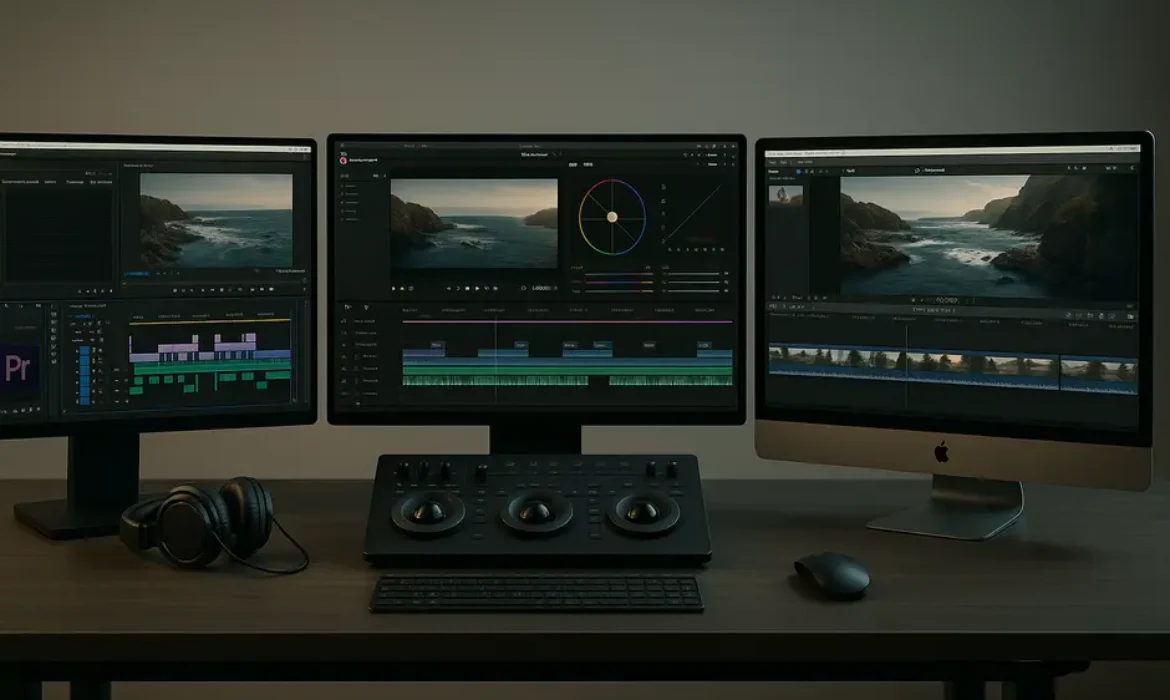
Adobe Premiere Pro vs DaVinci Resolve vs Final Cut Pro: Which Should Your Editor Use?
Estimated reading time: 15 minutes
Why This Comparison Still Matters in 2026
The conversation around professional NLE software has never been more relevant. Production pipelines have evolved dramatically over the past five years — remote teams are now the norm, camera formats have grown more demanding, and clients expect faster turnarounds without any compromise in quality. Choosing the wrong editing platform does not just slow your workflow down; it can genuinely limit what your team can deliver.
The three names that dominate the professional video editing landscape — Adobe Premiere Pro, DaVinci Resolve, and Final Cut Pro — each represent a genuinely different philosophy about how editing should work. One is built on ecosystem integration, another on post-production depth, and the third on raw speed within a closed hardware environment. None of them is universally superior. But one of them is almost certainly the right choice for your specific situation.
This guide breaks down exactly what each platform offers, where each one falls short, and which type of editor or production team benefits most from each. Whether you are a solo documentary filmmaker, a commercial post house, or a content creator scaling up to broadcast quality, this comparison will help you make a well-informed decision.
A Quick Overview of Each Platform
Before diving deep, it helps to understand the foundational identity of each tool.
Adobe Premiere Pro has been a staple of professional editing since it launched in its modern iteration in 2003. It sits inside the broader Adobe Creative Cloud ecosystem, which means seamless integration with After Effects, Audition, Photoshop, and Illustrator. For editors already working in that ecosystem, the integration is genuinely powerful rather than just a marketing talking point.
DaVinci Resolve, developed by Blackmagic Design, started life as a colour grading suite used exclusively in high-end Hollywood facilities. Blackmagic eventually rebuilt it into a full non-linear editing system. Today, DaVinci Resolve is the only platform that handles editing, colour grading, visual effects (through Fusion), audio post-production (through Fairlight), and collaborative media management — all within a single application.
Final Cut Pro is Apple’s professional editing platform, and it takes a distinctly different approach to NLE architecture. Rather than traditional track-based timelines, Final Cut Pro uses a magnetic timeline with a primary storyline model. It is macOS-exclusive, deeply optimised for Apple Silicon, and known for its extraordinary rendering and export speed on compatible hardware.
Each of these tools is used by working professionals at the highest levels of the industry. The question is which one fits your workflow.
Interface and Learning Curve
Interface design reflects the philosophy behind each tool, and understanding those philosophies helps you anticipate how long it will take for an editor to become productive.
Premiere Pro uses a familiar track-based timeline that anyone who has worked with traditional NLE software — including AVID Media Composer — will recognise immediately. Tracks stack vertically, clips sit on those tracks, and the paradigm is intuitive for editors coming from broadcast or news backgrounds. The interface is dense and customisable, which is both its strength and its occasional weakness. New users can feel overwhelmed by the sheer number of panels and options.
DaVinci Resolve organises itself around distinct pages — Cut, Edit, Fusion, Colour, Fairlight, and Deliver. This modular approach is elegant once you understand it, but it initially confuses editors who expect a single unified workspace. The Edit page behaves like a traditional NLE, while the Cut page offers a streamlined, faster-paced alternative for rough assembly. The Colour page is its own world entirely — one that professional colourists spend years mastering.
Final Cut Pro is arguably the most approachable for newcomers, but it challenges experienced editors with its non-standard magnetic timeline. Editors trained in track-based systems sometimes find the initial adjustment frustrating. However, those who invest the time almost universally report that it becomes faster for certain types of editing — particularly narrative and documentary work — once the muscle memory takes hold.
In practice, a skilled editor can become genuinely productive in Premiere Pro within days, DaVinci Resolve’s Edit page within a week or two, and Final Cut Pro within two to three weeks if they are coming from a track-based background.
Editing Performance and Proxy Workflows
Performance in real-world editing is not just about spec sheet benchmarks. It is about how smoothly a platform handles your specific camera formats, your hardware configuration, and your delivery requirements.
Final Cut Pro consistently sets the benchmark for raw performance on Apple hardware. Its optimised use of Apple Silicon, combined with native support for ProRes and ProRes RAW, means editors on M-series MacBook Pros can cut 4K and even 8K footage in real time with minimal dropped frames. Apple’s ProRes codec documentation illustrates why ProRes has become the industry’s preferred intermediate format — and Final Cut Pro treats it as a first-class citizen. The magnetic timeline also contributes to speed, reducing the friction of basic cuts and trims.
DaVinci Resolve has made significant strides in performance, particularly with GPU acceleration. It leverages CUDA (NVIDIA) and Metal (Apple) to offload processing, and Blackmagic’s proxy workflow — using optimised media generated in the Media Pool — is straightforward and well-integrated. For editors working with heavy visual effects or intensive colour work, Resolve’s GPU utilisation is genuinely impressive. The challenge arises on lower-end hardware; Resolve can feel sluggish without a capable GPU and sufficient RAM (Blackmagic recommends at least 16GB, though 32GB is the practical minimum for professional work).
Premiere Pro supports a wide range of camera formats natively and has improved its GPU acceleration through the Mercury Playback Engine. Its proxy workflow is functional, though some editors find it slightly more convoluted to set up compared to Resolve or Final Cut Pro. Premiere Pro also has a history of RAM usage concerns — though recent updates have addressed many of these issues — and performance can vary considerably depending on system configuration, codec choice, and the number of third-party plugins installed.
For editors primarily on Windows machines working with RED, ARRI, or Sony Venice footage, Premiere Pro and DaVinci Resolve are the practical options since Final Cut Pro simply does not exist on that platform.
Colour Grading Capabilities
This is where the comparison becomes genuinely unequal.
DaVinci Resolve’s Colour page is the industry standard for professional colour grading, and calling it merely “robust” would be underselling it. The node-based colour pipeline, the precision of its scopes, the depth of its HDR tools, and its implementation of colour science — including its own DaVinci Wide Gamut colour space — represent decades of refinement from a company whose tools were grading Hollywood features long before they built an NLE. Films graded in Resolve include everything from major studio releases to award-winning independent productions. For any production where colour is a primary deliverable, Resolve is in a category by itself.
Final Cut Pro offers capable colour tools, including colour wheels, curves, and a dedicated Colour Inspector. Apple’s Colour Finale plugin (a third-party addition) significantly extends what is possible. However, for professional colourists, Final Cut Pro’s colour environment feels constrained compared to Resolve’s. It handles basic primary and secondary corrections well and produces excellent results when working within its ProRes ecosystem, but it is not a tool professional colourists tend to choose for complex, client-facing colour work.
Premiere Pro’s Lumetri Colour panel is accessible and functional, offering scopes, curves, HSL secondary corrections, and Creative LUT support. For editors who need to do their own colour work as part of a finishing pipeline, Lumetri gets the job done. For dedicated colourists, it lacks the precision and depth of Resolve’s toolset. That said, Premiere’s tight integration with After Effects allows for complex compositing workflows that colourists sometimes leverage on heavily effects-driven projects.
In many professional pipelines, the practical answer to colour grading is to edit in Premiere Pro or Final Cut Pro and then round-trip to DaVinci Resolve for colour — a workflow that is well-documented and widely used in the industry.
Collaborative Editing and Team Workflows
As productions grow, the ability for multiple team members to work on the same project simultaneously becomes critical.
DaVinci Resolve offers the most sophisticated collaborative editing solution in the comparison through DaVinci Resolve’s collaborative workflow feature, available in both the free and Studio versions. Multiple editors can work on the same timeline simultaneously using a PostgreSQL database, with bin locking, timeline locking, and real-time updates. For larger post houses, this is a genuine differentiator. The Blackmagic Cloud feature also enables remote collaboration without requiring a local server infrastructure.
Adobe Premiere Pro supports collaborative work through Productions — a feature introduced for managing large-scale projects with multiple editors. Productions allows editors to work in separate but linked project files that share bins and assets. It is a well-designed system for broadcast and film productions, though it requires careful setup and some discipline from the team to avoid conflicts. Adobe also offers integration with Frame.io (which Adobe acquired in 2021) for client review and approval workflows.
Final Cut Pro handles collaboration through libraries stored on shared storage, and while multiple editors can work on separate projects within the same library, true simultaneous multi-editor collaboration on the same timeline is not natively supported in the way Resolve handles it. For smaller teams working in a structured handoff workflow, this is manageable. For larger post houses requiring real-time collaboration, it is a limitation worth acknowledging.
Export Formats and Delivery
| Platform | Broadcast Formats | ProRes Support | H.264/H.265 | HDR Export | DCP Output |
|---|---|---|---|---|---|
| Premiere Pro | Excellent | Yes (via Media Encoder) | Yes | Yes | Via third-party |
| DaVinci Resolve | Excellent | Yes | Yes | Yes (native) | Yes (Studio) |
| Final Cut Pro | Excellent | Native, first-class | Yes | Yes | Via third-party |
DaVinci Resolve Studio (the paid version) includes the most comprehensive delivery options, including native DCP output for theatrical delivery — a significant advantage for cinema-focused productions. The Deliver page is thoughtfully designed and offers custom presets that make multi-format delivery efficient.
Premiere Pro, through Adobe Media Encoder, handles virtually every delivery format a professional is likely to encounter. Media Encoder runs as a background application, allowing editors to continue working while exports render — a practical time-saver in deadline-heavy environments.
Final Cut Pro excels at fast ProRes export and has exceptional direct export speeds on Apple Silicon. Its Share destinations system simplifies delivery for common targets, though complex custom delivery workflows sometimes require Compressor (Apple’s companion encoding application).
Pricing: Real Cost vs Perceived Value
| Platform | Pricing Model | Cost |
|---|---|---|
| Adobe Premiere Pro | Subscription (Creative Cloud) | Approximately $55/month (single app) or $60/month (All Apps) |
| DaVinci Resolve | Free version available; Studio is a one-time purchase | Free / $295 USD (Studio, perpetual licence) |
| Final Cut Pro | One-time purchase | $299.99 USD (Mac App Store) |
DaVinci Resolve offers an extraordinary free tier. The free version includes virtually everything a professional editor or colourist needs for standard deliverables. The Studio version adds collaborative tools, noise reduction, certain AI-powered features, and DCP output — and it is a one-time purchase rather than a recurring subscription. For freelancers or small studios managing software costs carefully, this makes Resolve an almost irresistible value proposition.
Final Cut Pro at $299.99 is a one-time cost that covers all future updates within the current major version. Given the pace at which Apple updates the software, this has historically been excellent value, particularly for Mac-committed workflows.
Premiere Pro is the most expensive option on an ongoing basis. For organisations already paying for Adobe Creative Cloud All Apps — which many agencies and design firms do — the incremental cost is less significant. But for a video-focused operation with no other Creative Cloud dependency, paying over $600 annually for a subscription is a real consideration.
Which Editor Should Use Which Tool?
The honest answer is that tool selection should follow workflow requirements rather than personal loyalty or convention. Here is a practical breakdown:
Choose Premiere Pro if:
- Your team is already embedded in the Adobe Creative Cloud ecosystem
- You frequently work alongside motion graphics artists using After Effects
- You edit on Windows machines or cross-platform teams
- Your projects involve complex audio workflows that benefit from Audition integration
Choose DaVinci Resolve if:
- Colour grading is a primary or significant deliverable
- You want professional-grade tools without a subscription commitment
- Your production requires true simultaneous multi-editor collaboration
- You handle theatrical or broadcast delivery requiring precise colour science
- You are building or scaling a post-production studio from the ground up
Choose Final Cut Pro if:
- Your team is entirely on Mac hardware, particularly Apple Silicon
- Editing speed and performance are the highest priorities
- You are a solo editor or part of a small team without complex collaboration needs
- You primarily work in ProRes-based workflows
- You edit high-volume content where turnaround speed is commercially significant
Head-to-Head Comparison Table
| Feature | Premiere Pro | DaVinci Resolve | Final Cut Pro |
|---|---|---|---|
| Platform | Mac, Windows | Mac, Windows, Linux | Mac only |
| Pricing | $55/month | Free / $295 (Studio) | $299.99 (one-time) |
| Learning Curve | Moderate | Moderate–Steep | Moderate |
| Colour Grading | Good (Lumetri) | Industry-leading | Capable |
| Multi-editor Collaboration | Yes (Productions) | Yes (native, robust) | Limited |
| Performance (Apple Silicon) | Good | Good | Exceptional |
| Ecosystem Integration | Adobe CC | Blackmagic | Apple |
| VFX Integration | After Effects | Fusion (built-in) | Motion (separate) |
| Audio Post | Audition integration | Fairlight (built-in) | Logic Pro / third-party |
| Free Version | No | Yes | No (30-day trial) |
| DCP Output | Third-party | Studio version | Third-party |
| Best For | Agency / broadcast teams | Colour-critical / cinema | Fast Mac-based workflows |
Key Takeaways
-
- DaVinci Resolve is the most complete post-production platform available today, and its free tier makes it accessible to anyone without financial barriers. For colour-critical work, it is in a league of its own
- Final Cut Pro is unmatched for raw editing performance on Apple Silicon and represents exceptional long-term value for Mac-based operations. Its speed advantages are real and measurable, not marketing language
- Premiere Pro’s primary competitive advantage is its deep integration with the Adobe Creative Cloud ecosystem and its cross-platform availability. For teams already invested in Adobe tools, it remains the most logical choice
- Colour grading and NLE choice can be separated. Many professional pipelines edit in Premiere or Final Cut and grade in Resolve — a round-trip workflow that combines the strengths of multiple tools
- There is no universally correct answer. The right platform is the one that best fits your specific hardware, team structure, delivery requirements, and existing software investments
FAQs
Q1: Is DaVinci Resolve really free, or is the free version too limited for professional work?
The free version of DaVinci Resolve is genuinely professional-grade. It includes the full Edit, Cut, Fusion, Colour, and Fairlight pages with no watermarks and no time limits on projects. The Studio version ($295, one-time) adds specific features including multi-user collaboration without a server, certain AI-powered audio and video tools, noise reduction powered by neural engine processing, and native DCP output for cinema delivery. For the vast majority of professional video editors, colourists, and filmmakers, the free version covers everything they need. The Studio version is worth the investment only if you specifically require those additional capabilities.
Q2: Can Premiere Pro and DaVinci Resolve work together in the same pipeline?
Absolutely, and this is a common professional workflow. Editors will cut a project in Premiere Pro, then export an XML or AAF file that DaVinci Resolve can import. Resolve reconforms the project against the original camera files, allows the colourist to grade the footage, and then the finished master is exported. This round-trip workflow is well-documented and widely used in commercial and narrative film production. It allows teams to use the tool that each specialist knows best rather than forcing a single platform on everyone.
Q3: Is Final Cut Pro worth learning if you already know Premiere Pro?
For editors committed to Mac hardware, particularly those working on M-series chips, the performance gains from Final Cut Pro are significant enough to justify the learning investment. The magnetic timeline takes adjustment, but most editors report that after four to six weeks, their editing speed exceeds what they achieved in Premiere Pro. If you occasionally need to hand off projects to Windows-based teams or post houses, the lack of cross-platform support is a real constraint. If your world is entirely Mac-based and speed is commercially important, the transition is worth serious consideration.
Q4: How does AVID Media Composer fit into this comparison?
AVID Media Composer is the fourth major player in professional NLE software and remains dominant in broadcast television and major film post-production, particularly in the United States. Networks like HBO, NBC, and many film studios standardise on AVID because of its mature bin-based media management, its decades of integration with broadcast infrastructure, and its robust collaborative workflows. If you are targeting a career in broadcast TV or major studio features, knowing AVID is still commercially valuable. For most other applications — commercial work, documentary, digital content, independent film — Premiere Pro, Resolve, or Final Cut Pro will serve you better and cost considerably less.
Q5: Which platform handles HDR colour workflows best?
DaVinci Resolve handles HDR workflows with greater depth and precision than any competing NLE. Its native support for HDR10, Dolby Vision, and HLG, combined with its colour science tools and accurate scopes for HDR monitoring, make it the platform of choice for productions delivering HDR masters for streaming platforms. Apple’s HDR pipeline within Final Cut Pro is also strong, particularly for HDR ProRes workflows targeted at Apple TV+. Premiere Pro supports HDR export through Lumetri and Media Encoder but lacks the grading depth of Resolve for complex HDR finishing.
Q6: Which editing software do most professional editors use in 2026?
Usage varies significantly by market segment. According to industry surveys and production data, Adobe Premiere Pro maintains the largest installed base among commercial agencies, marketing teams, and content creators. DaVinci Resolve has seen rapid adoption growth, particularly among independent filmmakers and post-production facilities, driven largely by its pricing model and colour capabilities. Final Cut Pro retains a strong professional user base among Mac-centric editorial departments and independent editors in markets like Australia, Canada, and the UK. AVID continues to dominate broadcast television workflows. There is genuinely no single dominant platform across all professional contexts — which is itself an important data point when making your own decision.
Q7: How important is GPU specification when choosing between these platforms?
GPU specification matters most for DaVinci Resolve and, to a lesser extent, Premiere Pro. Resolve’s colour engine, Fusion compositor, and noise reduction tools are GPU-accelerated, and the difference between working on a mid-range GPU versus a high-end workstation GPU is tangible in real time. Blackmagic recommends at least 8GB of VRAM for Resolve, and 16GB or more for intensive colour grading with HDR or visual effects work. Final Cut Pro benefits most from Apple’s unified memory architecture in M-series chips rather than discrete GPU VRAM. Premiere Pro’s Mercury Playback Engine uses GPU acceleration but is generally less GPU-demanding than Resolve for equivalent tasks.
Conclusion
The debate between Premiere Pro, DaVinci Resolve, and Final Cut Pro is not one that resolves with a single winner — and any comparison that tells you otherwise is oversimplifying the reality of professional post-production. These are three mature, powerful, and genuinely distinct tools that reflect different priorities, different hardware environments, and different workflows.
If there is one overarching truth in this comparison, it is that the best platform is the one that removes friction from your specific workflow. An editor working on a high-volume commercial pipeline embedded in Adobe Creative Cloud will be more productive in Premiere Pro than they would be if forced to switch to Resolve, regardless of what the feature matrix suggests. A colourist finishing a streaming drama needs Resolve’s colour page — full stop. A solo Mac editor cutting documentary features for fast turnaround will find Final Cut Pro gives them a genuine competitive advantage in delivery speed.
What is increasingly common — and increasingly sensible — is the use of multiple platforms within a single pipeline, leveraging each for what it does best rather than treating the choice as a binary commitment. The tools interoperate well enough to support this, and the best post-production teams tend to be the ones who care more about the quality of the work than loyalty to any particular piece of software.
Invest the time to understand what your workflow actually demands, evaluate the hardware your team works on, and consider your long-term cost structure. Then make the decision based on evidence rather than convention.
For official documentation and release notes, visit Adobe Premiere Pro’s official page, Blackmagic Design’s DaVinci Resolve page, and Apple’s Final Cut Pro page.