What to Look for When Hiring a Video Editing Service (7 Non-Negotiables)
Estimated reading time: 16 minutes
Why This Decision Matters More Than You Think
Video content is no longer optional. It is the dominant format across social media, e-commerce, corporate communications, and digital marketing. According to Wyzowl’s State of Video Marketing report, 91% of businesses use video as a marketing tool, and the demand for faster, higher-quality output continues to climb year over year.
That pressure lands squarely on whoever is responsible for post-production. If you are handling video in-house and running into capacity issues, or if you are a content creator whose upload schedule is being strangled by editing backlogs, the appeal of outsourcing is obvious. But hiring the wrong video editing service can cost you far more than time and money. It can cost you brand consistency, client relationships, and content quality that you will never fully recover.
This guide cuts through the noise. Whether you are a brand manager, agency owner, YouTube creator, or production company looking to scale, these seven non-negotiables will help you evaluate any video editing company with the kind of scrutiny the decision deserves.
Non-Negotiable #1: Portfolio That Actually Matches Your Needs
Look Beyond the Highlight Reel
Every video editing service will show you their best work. That is expected. What separates a useful portfolio review from a superficial one is whether the work they are showcasing is relevant to what you actually need.
A service that produces stunning wedding films or cinematic brand documentaries may be completely out of their depth when it comes to fast-paced social media reels, e-learning module editing, or long-form YouTube content with complex chapter structures. These formats require different pacing instincts, attention to audience retention patterns, and platform-specific best practices.
When reviewing any editor’s portfolio, ask these specific questions:
- Have they worked in your specific content category (YouTube, ads, corporate, documentary, social)
- Does the pacing of their edits match the energy level your audience expects
- Can you see evidence of motion graphics, color grading, or sound design, if those matter to you
- Is there variety that demonstrates adaptability, or does everything look the same
Request Category-Specific Samples
Do not settle for whatever is on their homepage. Ask directly for samples from your niche. A reputable service will have no issue pulling relevant work. If they deflect or tell you everything in their portfolio is representative, take note. That is a flag.
Also pay attention to the diversity of client results. Editing the same type of content for one long-term client looks very different from demonstrating range across multiple industries and formats.
Non-Negotiable #2: Clear Revision Policy (Not Just “Unlimited”)
The “Unlimited Revisions” Trap
If you have spent any time evaluating freelancers or agencies, you have seen this phrase plastered everywhere: “unlimited revisions.” It sounds generous. In practice, it is often meaningless.
What matters is not how many revisions you get — it is how the revision process actually works. Consider these scenarios:
- Does each revision require a new 48–72 hour wait
- Are there limits on the scope of revisions (minor tweaks vs structural changes)
- Is there a designated revision round, or is it an open-ended back-and-forth
- Do revisions reset the timeline, affecting other deliverables
A well-run video editing service will have a documented revision workflow. They will specify what constitutes a revision versus a new project, and they will have a system that allows you to submit timestamped feedback efficiently.
What a Healthy Revision Policy Looks Like
| Element | Red Flag | Green Flag |
|---|---|---|
| Number of rounds | “Unlimited” with no defined scope | 2–3 structured rounds with clear scope |
| Feedback method | Email back-and-forth | Dedicated review platform (e.g., Frame.io) |
| Turnaround per revision | Unspecified | Defined (e.g., 24–48 hours per round) |
| Scope definition | Everything is a “revision” | Clear distinction between minor edits and new work |
| Major structural changes | Included without limit | Priced separately or negotiated upfront |
Services that use collaborative review tools like Frame.io or Wipster are already ahead of the curve. These platforms allow you to leave precise, timestamped comments directly on the video, dramatically reducing miscommunication and revision loops.
Non-Negotiable #3: Realistic and Reliable Turnaround Time
Speed Means Nothing Without Consistency
Turnaround time is one of the most frequently discussed criteria when choosing a video editor, yet it is also one of the most misunderstood. A company that promises a 24-hour turnaround might deliver the first edit in 18 hours and the fifth in 96. What you need is not speed — it is predictability.
Your content calendar depends on consistent delivery windows. If you are publishing three YouTube videos per week, or managing social content for ten clients simultaneously, a single late delivery can cascade into missed posting windows, scrambled schedules, and frustrated clients.
Questions to Ask About Turnaround
Before signing any agreement, clarify:
- What is the standard turnaround for your specific video length and complexity
- What is the turnaround during high-volume periods or holidays
- Is there a rush delivery option, and what does it cost
- How are delivery delays communicated
- What is the SLA (Service Level Agreement) if they miss a deadline
The best video editing services will build these answers into their contract rather than leaving them vague. Vague turnaround commitments are almost always a sign that delivery reliability is inconsistent.
The Volume Consideration
If you are submitting 20 or 30 videos per month, your turnaround needs will be very different from someone submitting two. Ask specifically how the service handles surge capacity. Do they assign additional editors? Prioritize by submission order? This matters enormously for agencies and high-volume content operations.
Non-Negotiable #4: A Dedicated Editor (Not a Rotating Roster)
Why Consistency Beats Convenience
One of the most underrated criteria in any video editing service review is editor consistency. Many services — particularly subscription-based platforms and larger agencies — operate on a pool model. Each project gets assigned to whoever is available at the time. On the surface, this maximizes their operational efficiency. For you, it often means starting from scratch every time.
When a new editor picks up your project, they have to learn your preferences, your brand’s tone, your audience’s expectations, and all the small nuances that make your content feel distinctly yours. That learning curve does not disappear — it just gets absorbed as extra revision rounds, slower initial edits, and inconsistent output.
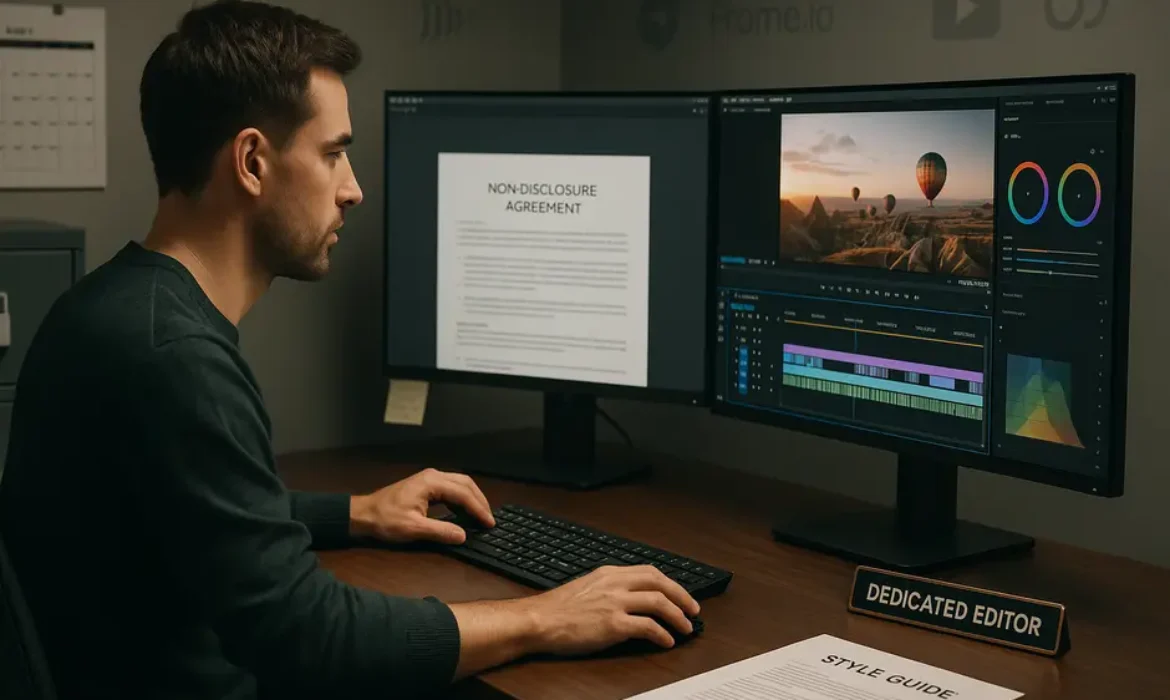
A dedicated editor is one of the single most valuable assets a video editing service can offer. Over time, a good editor becomes an extension of your creative team. They anticipate what you want before you ask for it. They flag things that do not fit your style before sending a draft. That kind of institutional knowledge compounds in value.
How to Ask the Right Questions
When evaluating a service, ask explicitly:
- Will the same editor handle all of my projects
- What happens if my dedicated editor is unavailable — who covers, and how is knowledge transferred
- Can I request a different editor if the fit is not right
- Is there a way to build a style reference document that any backup editor would receive
Some services allow you to build a detailed style guide (more on that next) and attach it to every new submission, which partially mitigates the dedicated-editor gap. But if you are producing content that depends heavily on voice, rhythm, and tonal consistency, a dedicated editor is non-negotiable.
Non-Negotiable #5: Style Guide Compatibility and Brand Consistency
Your Brand Has a Rhythm. Your Editor Needs to Feel It.
Professional video editing criteria extend well beyond technical skill. A great editor can execute a technically clean cut and still miss the mark entirely if they do not understand your brand. Color palette decisions, font usage, intro/outro formats, music tempo preferences, pacing rhythm — these are all elements that define how your content feels to your audience.
A style guide is the solution, but only if the editing service actually supports its use. Before committing to any service, find out:
- Do they accept and document style guides for each client
- Where is the style guide stored, and does every relevant editor have access
- Do they have an onboarding process that captures your preferences before the first project begins
What a Video Style Guide Should Include
If you do not already have one, building a style guide is worth the upfront investment. A solid one typically covers:
- Brand colors (hex codes) and typography
- Preferred music genres, tempo, and licensing sources
- Intro and outro templates
- Text animation style and duration preferences
- Caption formatting (font size, position, background treatment)
- Preferred pacing by content type (e.g., fast cuts for social, slower pace for explainers)
- Tone descriptors (energetic, calm, authoritative, conversational)
- Examples of edits you love and why
Hand this document to any new editing service at the start of the relationship. If they receive it with enthusiasm and ask clarifying questions, that is a sign of a professional team. If they barely acknowledge it, expect to be disappointed.
Non-Negotiable #6: NDAs, Contracts, and Data Security
Your Content Is Valuable. Protect It.
This is the area most people skip until something goes wrong. When you hire a video editing service, you are often sharing unedited footage, client data, proprietary workflows, and sometimes confidential information embedded in the raw material. The service needs to be held to clear legal and ethical standards around how that content is handled.
At minimum, any professional video editing service should:
- Offer a Non-Disclosure Agreement (NDA) upon request, or include confidentiality clauses in their standard contract
- Clearly state how footage is stored, for how long, and who has access
- Specify what happens to raw and edited files after project completion
- Clarify whether your content will be used in their portfolio or promotional materials (and allow you to opt out)
The white-label question is particularly important for agencies. If you are a marketing agency delivering video editing as part of your service offering, your clients should never see the name of the third-party editing service. A white-label video editing arrangement means the service operates invisibly under your brand. Confirm this explicitly and get it in writing.
A Note on Data Storage and Security
Ask where files are stored. Reputable services use secure cloud infrastructure — typically AWS, Google Cloud, or similar enterprise-grade providers. Understand how footage transfer works. Are you uploading to a proprietary portal? Sharing via Dropbox? Using WeTransfer? Each option has different security implications, particularly if your content involves unreleased products, identifiable individuals, or confidential client information.
For agencies operating under GDPR or CCPA obligations, this conversation is not optional — it is a compliance requirement.
Non-Negotiable #7: Transparent Pricing and Scalability
What You See Should Be What You Pay
Pricing structures for video editing services vary enormously. Per-minute pricing, per-project pricing, monthly subscription tiers, hourly rates, and retainer agreements all exist in this space. None of these models is inherently better than another — what matters is whether the pricing structure aligns with your volume, your complexity, and your budget predictability needs.
The red flag is not any particular pricing model. The red flag is opacity. Services that cannot give you a clear answer about what you will pay for a standard project, or that bury overage fees in the fine print, will cost you more than their listed rate.
Common Pricing Models Compared
| Pricing Model | Best For | Watch Out For |
|---|---|---|
| Per-minute of finished video | Predictable output volume | Fees escalating with longer projects |
| Per-project flat rate | One-off or variable projects | Scope creep without agreed change orders |
| Monthly subscription (tiered) | Consistent monthly volume | Rollover policies and unused credit |
| Hourly rate | Complex, hard-to-scope projects | Estimates that balloon without caps |
| Retainer | Long-term agency or brand relationships | Flexibility limits and cancellation terms |
Scalability Is the Real Test
A service that works well for five videos per month may buckle under 30. Before you commit, ask directly: how do they handle growth? Can they scale with you? Is there a dedicated account manager who helps manage capacity and prioritization as your volume increases?
An account manager is often the difference between a smooth partnership and a chaotic one at scale. They serve as the single point of contact for issues, revisions, billing questions, and strategic conversations. If the service you are considering assigns you a ticket number instead of a person, manage your expectations accordingly.
Bonus Criteria Worth Evaluating
Beyond the seven non-negotiables, these additional factors can significantly influence the quality and longevity of a video editing partnership:
- Communication responsiveness: How quickly do they respond to questions? Is there a real human on the other end, or are you navigating automated replies?
- Software proficiency: Do they work in the industry-standard tools you need — Adobe Premiere Pro, Final Cut Pro, DaVinci Resolve? Can they handle the file formats you work in?
- Editor experience and background: How long have they been editing? Do they have experience in your specific content category? Some services provide editor bios; if yours does not, ask.
- Platform-specific expertise: Editing for YouTube is different from editing for TikTok, LinkedIn, or broadcast. Confirm that the editors understand the technical and stylistic requirements of your target platform.
- Sound design and color grading capability: These are distinct skills. Many basic editing services outsource or skip these elements. If they are important to your content quality, verify upfront.
The Video Editing Service Checklist
| Criteria | Questions to Ask | Status |
|---|---|---|
| Portfolio review | Does their work match your content category and style? | |
| Revision policy | Are rounds defined, scoped, and supported by a feedback tool? | |
| Turnaround time | Is there a documented SLA with consistency guarantees? | |
| Dedicated editor | Will the same editor handle ongoing work? | |
| Style guide support | Do they have an onboarding process for brand preferences? | |
| NDA and data security | Are confidentiality and file handling clearly documented? | |
| Pricing transparency | Is pricing clear, with defined scope and overage policies? | |
| Account manager | Is there a named contact for escalations and strategic direction? | |
| White-label capability | If relevant, will they operate under your brand identity? | |
| Scalability | Can they handle your projected growth in volume? |
Frequently Asked Questions
Q1: How much should I expect to pay for a professional video editing service?
Pricing varies based on scope, complexity, and service model. Per-minute rates typically range from $15 to $75 for standard edits, with premium services charging more for motion graphics, color grading, or complex timelines. Monthly subscriptions for unlimited editing (within defined parameters) range from $500 to $3,000 or more depending on volume and turnaround guarantees. The most important benchmark is not the rate itself — it is whether the rate reflects a clearly defined scope that matches your needs.
Q2: Is it better to hire a freelance video editor or a video editing service?
Both have legitimate use cases. Freelancers offer flexibility and often more direct creative collaboration, but they carry availability risk and may not scale with your needs. Editing services offer more reliability, structured workflows, and backup capacity, but can feel less personal. For businesses producing consistent, high-volume content, a structured editing service generally outperforms a solo freelancer over time. For highly creative, one-off projects, a specialized freelancer may be the better choice.
Q3: What does “what makes a good video editor” actually mean beyond technical skill?
Technical proficiency is the floor, not the ceiling. What truly distinguishes an exceptional editor is their storytelling instinct — the ability to shape raw footage into a narrative arc that holds attention. Beyond that, the best editors are proactive communicators who flag problems before you see them in a draft, have a deep intuition for pacing, understand platform-specific viewer behavior, and treat your brand as if it were their own. These qualities are harder to evaluate than software skills but matter far more in a long-term working relationship.
Q4: How do I evaluate a video editing company I have never worked with before?
Request a trial project before committing to a monthly plan or contract. A reputable service will typically offer a paid or discounted trial edit. During this process, evaluate not just the output quality, but the communication process, how they handle your feedback, and whether they ask intelligent questions before starting. The first project often reveals more about a service than any sales conversation.
Q5: What is a white-label video editing service, and do I need one?
A white-label video editing service operates entirely behind your brand. They edit content on your behalf, but no branding, watermarks, or credits from the editing company appear on the final output or in any client-facing communication. If you are an agency offering video editing as part of your service package, this arrangement is essential. Without it, your clients may discover you are outsourcing, which can damage trust and contract terms. Always confirm white-label terms in writing.
Q6: How important is turnaround time compared to edit quality?
Context determines priority. If you are running time-sensitive campaigns or maintaining a rigid publishing calendar, turnaround reliability directly impacts business outcomes and is arguably more critical than marginal quality differences. If you are producing brand films, documentaries, or cornerstone content pieces, quality should take precedence over speed. The best services offer both — but if you are ever forced to prioritize, align your choice with your content’s strategic purpose.
Q7: Can I switch video editing services after building a relationship with one?
Yes, but the transition carries a cost. The new service will need time to understand your brand, style, and preferences. To minimize disruption, document your style guide comprehensively before switching, collect all raw footage from your previous service (check contract terms for file ownership), and plan for a longer-than-usual ramp-up period on early projects. Treat the transition like onboarding a new team member, not flipping a switch.
Key Takeaways
-
- A strong portfolio is necessary but not sufficient. Relevant samples in your specific content category matter far more than generic highlight reels
- “Unlimited revisions” is marketing language. What matters is a defined, scoped revision process with clear turnaround windows
- Predictable turnaround time matters more than fast turnaround time, especially for high-volume operations
- A dedicated editor builds compounding value over time that a rotating roster cannot replicate
- Style guide compatibility determines whether your brand consistency survives the outsourcing process
- NDAs and data security are not optional extras — they are baseline professional standards that protect your content and your clients
- Transparent pricing and a named account manager are the strongest indicators of a service built for long-term partnerships, not short-term transactions
Final Thoughts
Hiring a video editing service is a meaningful business decision, and it deserves the same rigor you would apply to hiring any key team member or vendor. The criteria outlined here are not about being demanding — they are about protecting your brand, your content pipeline, and ultimately your relationship with your audience.
The services worth hiring will have clear answers to every question in this guide. They will not hedge on revision scopes, go quiet on NDA requests, or dodge questions about dedicated editors. Transparency is the baseline standard for any professional editing partnership.
Take your time, ask the right questions, and run a trial before making long-term commitments. The right editing partner does not just save you time — they actively improve the quality of your content and give you the creative bandwidth to focus on what you do best.