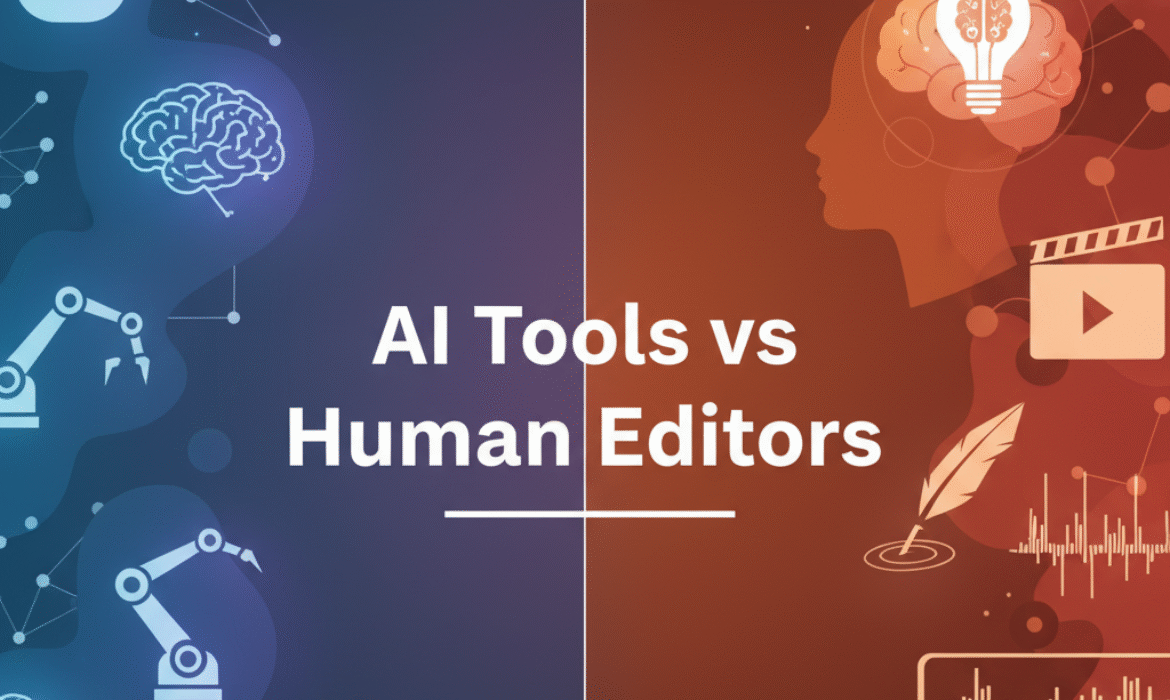
The video editing landscape has transformed dramatically over the past few years. What once required hours in a professional editing suite can now be accomplished in minutes with artificial intelligence-powered software. But does faster always mean better?
If you’re running a marketing team, managing a YouTube channel, or building a content business, you’ve probably asked yourself whether investing in AI editing tools makes more sense than hiring a professional editor. The answer isn’t as straightforward as many software companies would have you believe.
This comparison breaks down the real costs, time savings, and quality trade-offs between AI video editing tools and human editors. By the end, you’ll understand exactly when to use each approach—and how to combine both for maximum efficiency.
Understanding the Current State of AI Video Editing
AI video editing has moved far beyond simple templates and automated cuts. Modern platforms like Descript, Runway ML, and Adobe Premiere’s Sensei technology can now perform tasks that would have seemed impossible just three years ago:
- Automatic transcription and text-based editing
- Smart scene detection and removal of silence
- Facial recognition for multi-camera switching
- Auto-captioning with speaker identification
- Basic color grading and audio enhancement
- B-roll suggestions based on script content
According to research from Grand View Research, the AI video editing software market is expected to grow at a compound annual growth rate of 6.2% through 2030, driven primarily by the demand for faster content production cycles.
But these tools still have significant limitations. They struggle with creative storytelling, emotional pacing, brand consistency, and the nuanced decision-making that separates memorable content from forgettable noise.
Cost Comparison: AI Editing Tools vs Human Editors
AI Video Editing Tool Costs
Most AI editing platforms operate on subscription models with tiered pricing:
Entry-Level Tools ($10-30/month)
- Descript Creator: $24/month
- Pictory Standard: $23/month
- Kapwing Pro: $16/month
Professional Tools ($50-150/month)
- Descript Pro: $40/month
- Runway Standard: $76/month
- Adobe Premiere Pro (with AI features): $54.99/month
Enterprise Solutions ($300-1,000+/month)
- Custom transcription limits
- Team collaboration features
- Priority processing
- API access
These costs are predictable and scalable. Whether you produce 5 videos or 500, your monthly subscription remains constant. However, you’ll still need someone on your team to oversee the process, review outputs, and make creative decisions.
Human Editor Costs
The range here is considerably wider and depends on skill level, location, and employment structure:
Freelance Editors
- Beginner: $15-35/hour or $50-150/video
- Intermediate: $35-75/hour or $150-500/video
- Expert: $75-200+/hour or $500-3,000+/video
In-House Editors
- Junior editor salary: $40,000-55,000/year
- Mid-level editor: $55,000-75,000/year
- Senior editor: $75,000-120,000/year
Agency Services
- Small agency: $1,000-5,000/video
- Established agency: $5,000-25,000+/video
The math gets interesting when you factor in volume. If you’re producing 20 short videos monthly, an AI tool at $40/month costs you $2 per video, while even a budget freelancer at $100/video costs $2,000 monthly.
But this calculation ignores a crucial variable: revision time and final quality.
Time Analysis: Speed vs Thoroughness
AI Editing Speed Advantages
AI tools excel at repetitive, time-consuming tasks:
- Transcription: What took 4 hours manually now takes 5 minutes
- Silence removal: Automated across an entire video in seconds
- Auto-captions: Generated instantly with 85-95% accuracy
- Template application: Consistent branding applied in clicks
- First-cut assembly: AI can create a rough cut from raw footage in minutes
For podcast clips, social media snippets, and basic educational content, these time savings are transformative. A task that might take a human editor 3-4 hours can be completed in 20-30 minutes with AI assistance.
Where Human Editors Still Win on Efficiency
Counterintuitively, professional human editors often work faster on complex projects because they:
- Make better initial decisions, reducing revision cycles
- Understand creative briefs without multiple clarifications
- Navigate ambiguity that would stall an AI workflow
- Handle unexpected footage issues without starting over
- Deliver client-ready work with fewer rounds of feedback
An experienced editor might spend 8 hours on a project that would take you 12 hours with AI tools when you factor in learning curves, troubleshooting, and fixing AI mistakes.
Quality Comparison: Technical Precision vs Creative Excellence
What AI Does Well
Modern AI editing tools deliver impressive technical consistency:
Color Grading: AI can match color profiles across footage and apply professional LUTs (lookup tables) faster than manual grading. Adobe’s Auto Tone feature, for instance, analyzes thousands of professionally graded images to apply appropriate corrections.
Audio Cleanup: Tools like Descript’s Studio Sound can remove background noise, echo, and mouth clicks with remarkable effectiveness—work that previously required expensive plugins and expertise.
Pacing for Specific Formats: For predictable formats like talking-head videos or podcast clips, AI learns optimal pacing patterns and can cut filler words while maintaining natural rhythm.
Where Human Creativity Remains Irreplaceable
Storytelling: The difference between a video that informs and one that moves people to action lies in narrative structure, emotional pacing, and creative transitions. These elements require human judgment about audience psychology, brand voice, and strategic messaging.
Brand Consistency: While AI can apply visual templates, it doesn’t understand your brand’s personality. A human editor knows when to break the template for impact or when a certain music choice doesn’t align with your company values.
Complex Projects: Documentaries, narrative content, testimonial videos, and anything requiring multiple footage sources with different looks and purposes still demand human expertise. AI tools become assistants rather than solutions for this work.
Problem-Solving: When footage quality is poor, audio is problematic, or the original vision isn’t working, human editors adapt. They find creative solutions—AI tools simply fail or produce unusable results.
The Accuracy vs Creativity Trade-off
This represents the fundamental tension in comparing AI and human editing.
AI excels at accuracy for defined tasks. If you need to remove every “um” and “uh” from a 45-minute interview, AI will catch 95-98% of them without getting fatigued or losing focus.
But creativity requires intentional imperfection. Sometimes a pause creates dramatic tension. Sometimes a jump cut adds energy. Sometimes “breaking the rules” serves the story.
The best human editors combine technical precision with creative instincts developed over years of studying what works. They know when to follow editing conventions and when to discard them.
AI follows patterns. Humans create them.
Limitations and Weaknesses: Where Each Approach Falls Short
AI Editing Limitations
Context Blindness: AI doesn’t understand irony, sarcasm, or complex emotional tones. It might cut away from someone’s face at precisely the wrong moment because the algorithm detected a scene change.
Template Dependency: Most AI tools work best within predefined structures. Custom requests or unique creative visions often expose the technology’s current boundaries.
Learning Curve Despite Promises: While marketed as “easy,” most professional-grade AI tools require significant learning investment. You’ll spend hours understanding workflows, limitations, and optimal input requirements.
Quality Ceiling: There’s a noticeable ceiling to AI editing quality. It can make content “good enough” but rarely “exceptional” without human intervention.
Lack of Strategic Thinking: AI can’t understand that your video’s real goal is to position your CEO as a thought leader, or that this particular testimonial needs to emphasize trust over features.
Human Editor Limitations
Scalability Challenges: Human editors can only process so many videos. Scaling requires hiring more people, which adds management overhead, training time, and coordination complexity.
Inconsistency: Even experienced editors have off days. Fatigue, personal circumstances, and subjective preferences can create quality variations.
Higher Minimum Costs: For simple projects, paying a professional editor feels like using a Ferrari for grocery shopping—technically superior but economically inefficient.
Availability Constraints: Good editors book up quickly. Rush projects may force you to either wait or settle for available (but less skilled) alternatives.
Communication Overhead: Working with human editors requires clear briefs, feedback cycles, revision rounds, and relationship management. This “soft cost” is often underestimated.
AI Tools vs Freelancers vs Agency Editors: Choosing the Right Path
The decision framework depends on three primary factors: volume, complexity, and strategic importance.
When AI Tools Make the Most Sense
- High-volume, low-complexity content (social media clips, weekly podcasts, simple talking-head videos)
- Tight budgets with internal team members who can supervise
- Fast turnaround requirements for time-sensitive content
- Standardized formats where templates work well
- Organizations building internal content capabilities
Example Scenario: A SaaS company producing 30 short feature explanation videos monthly for social media. AI tools can handle the bulk of cutting, captioning, and formatting, with an internal marketing team member making final creative decisions.
When Freelance Editors Are Ideal
- Medium volume with varied content types
- Projects requiring creative input but not full agency services
- Budget-conscious production with quality standards
- Companies wanting flexibility without long-term commitments
- Specific expertise needed (animation, color grading, motion graphics)
Example Scenario: A consulting firm creating 6-8 client case study videos quarterly, each requiring interview editing, B-roll integration, and custom graphics. A trusted freelancer builds institutional knowledge about the brand while remaining cost-effective.
When Agency Editors Justify the Investment
- High-stakes content where brand reputation is critical
- Complex productions requiring full creative teams
- Campaigns needing strategic creative direction
- Limited internal expertise or bandwidth
- Projects where excellence differentiates market position
Example Scenario: A healthcare company launching a new service line with a multi-video campaign including patient testimonials, physician interviews, and facility tours. The strategic messaging and emotional resonance require agency-level expertise.
The Hybrid Approach: Combining AI Efficiency with Human Expertise
The most sophisticated content operations aren’t choosing between AI and human editors—they’re strategically combining both.
This hybrid workflow typically looks like:
- AI Handles Initial Processing
- Transcription and organization
- Removal of obvious mistakes (silence, filler words)
- Basic assembly and rough cuts
- Auto-captioning and initial formatting
- Humans Add Creative Value
- Storytelling structure and pacing decisions
- Emotional impact and brand alignment
- Complex transitions and graphics
- Strategic messaging refinement
- Final quality control
This approach can reduce human editing time by 30-50% while maintaining creative quality. According to professionals using this workflow, projects that previously took 10 hours might now require 5-6 hours of human work, with AI handling the remaining technical tasks.
Cost-Benefit Analysis: Real Numbers
Let’s examine a realistic scenario for a company producing educational content:
| Approach | Monthly Cost | Videos Produced | Time per Video | Quality Level |
|---|---|---|---|---|
| AI Only (with internal oversight) | $80 (software) + $25/hr × 20 hrs = $580 | 20 videos | 1 hour per video | Good for purpose |
| Freelance Editor Only | $200/video × 20 = $4,000 | 20 videos | Outsourced | Very good |
| Hybrid (AI + freelance review) | $80 + ($75/hr × 15 hrs) = $1,205 | 20 videos | 0.75 hours per video | Very good |
| In-house Junior Editor | $4,167 (monthly salary equivalent) | 15-20 videos | Variable | Good to very good |
The hybrid approach delivers the best cost-efficiency for this volume and quality requirement, saving approximately 70% compared to pure freelance work while maintaining quality standards.
Editing Quality Comparison: What “Quality” Actually Means
Quality in video editing isn’t monolithic—it encompasses multiple dimensions:
Technical Quality
- Color accuracy and consistency
- Audio levels and clarity
- Resolution and export settings
- Smooth transitions and cuts
Both AI and professional editors can achieve high technical quality, though AI requires proper input settings and can struggle with unusual footage conditions.
Creative Quality
- Narrative flow and story arc
- Emotional pacing and impact
- Visual interest and variety
- Alignment with brand voice
Human editors dramatically outperform AI here. The difference becomes obvious in A/B testing—audiences engage longer and take action more frequently with human-edited storytelling.
Strategic Quality
- Message clarity and positioning
- Call-to-action effectiveness
- Audience-specific adjustments
- Conversion optimization
This requires human strategic thinking. AI can’t understand that shortening the intro by 3 seconds might improve retention rates for your specific audience, or that emphasizing a particular testimonial moment strengthens trust at a crucial decision point.
AI Editing for Business vs Professional Services
Business use cases often have different priorities than creative projects:
Internal Communications: AI tools shine here. Company updates, training videos, and internal announcements benefit from speed and cost-efficiency more than creative brilliance.
Marketing Content: This requires balance. Top-of-funnel awareness content might work well with AI assistance, while high-stakes campaign videos justify professional editors.
Sales Enablement: Product demos and case studies fall in the middle. AI can handle the technical work, but human editors should craft the persuasive structure.
Thought Leadership: When your CEO is positioning themselves as an industry voice, or you’re creating content for major speaking opportunities, professional editing is non-negotiable. The quality difference directly impacts credibility.
Practical Decision Framework
Here’s a practical decision tree:
Ask these questions in order:
- Is this content format highly standardized?
- Yes → AI tools likely sufficient
- No → Continue evaluating
- What’s the strategic importance?
- Low stakes, informational → AI tools
- Brand-critical or revenue-driving → Professional editor
- Medium importance → Continue evaluating
- What’s your monthly volume?
- Under 5 videos → Freelance editor (avoid software learning curve)
- 5-25 videos → Hybrid approach
- Over 25 videos → AI tools with human oversight
- What’s your team’s editing literacy?
- High (experienced with editing software) → AI tools work well
- Low (no editing experience) → Freelance or agency better option
- Medium → Hybrid with gradual skill building
- How important is scalability?
- Critical for growth plans → Invest in AI workflows now
- Static volume expected → Human editors fine
- Uncertain → Start with freelancers, add AI as volume grows
Future Outlook: Where This Technology Is Heading
AI editing capabilities are advancing rapidly. Based on current development trajectories and statements from companies like Adobe, Runway, and Descript, we can expect:
Within 2 Years:
- Significantly improved context understanding
- Better handling of multiple speakers and complex audio
- More sophisticated template customization
- Enhanced collaboration features between AI and human editors
Within 5 Years:
- AI that understands brand voice from examples
- Automated A/B testing of different edit versions
- Real-time editing suggestions during video review
- Integration of generative AI for missing B-roll or graphics
What Won’t Change:
- Strategic creative direction will remain human
- High-stakes, brand-defining content will need human expertise
- Unusual or complex projects will challenge AI capabilities
- Audience understanding and emotional intelligence will differentiate human editors
The trajectory isn’t toward replacement—it’s toward augmentation. The most valuable skill set will be human editors who leverage AI tools to work faster while applying creative judgment that technology can’t replicate.
Frequently Asked Questions
Can AI video editing tools completely replace human editors?
Not yet, and probably not ever for all use cases. AI tools excel at specific, repetitive tasks like transcription, silence removal, and template-based editing. They’re transforming workflows for high-volume, standardized content such as social media clips, podcast episodes, and simple talking-head videos. However, they struggle with creative storytelling, brand consistency, emotional pacing, and complex projects requiring judgment calls. The most realistic future involves AI handling technical tasks while human editors provide creative direction and strategic decision-making. For simple, formulaic content with low stakes, AI can work independently. For anything requiring creative impact or brand-critical messaging, human expertise remains essential.
What’s the actual time saved when using AI editing tools compared to manual editing?
Time savings vary dramatically based on content type and complexity. For transcription, AI reduces a 4-hour manual process to about 5 minutes—a 98% time reduction. For removing filler words and silence from a 30-minute interview, AI completes in seconds what might take 45 minutes manually. For complete video production, the savings are more modest. A simple talking-head video that takes a professional editor 2-3 hours might take 45 minutes with AI tools—a 60-70% reduction. However, complex projects with multiple footage sources, creative transitions, and storytelling requirements might only see 20-30% time savings, as AI handles technical tasks but humans still need substantial time for creative work. The hybrid approach—AI for technical processing, humans for creative finishing—typically delivers 40-50% time savings while maintaining quality.
How much does AI video editing cost compared to hiring a professional editor?
The cost difference is substantial but requires context. AI tools range from $15-80 monthly for most professional needs, while human editors charge $50-3,000+ per video depending on complexity and expertise. For high-volume production, AI tools dramatically reduce per-video costs. If you produce 30 videos monthly, an AI subscription at $50/month costs $1.67 per video, while even a budget freelancer at $150/video costs $4,500 monthly. However, this ignores hidden costs: staff time to manage AI tools, learning curves, fixing AI errors, and potential quality limitations. Additionally, AI works best with internal oversight—someone still needs to make creative decisions and review output. The true comparison should factor in total cost of ownership: subscription fees plus internal labor for AI versus fully outsourced human editing. For simple, standardized content at volume, AI saves 70-90%. For complex creative projects, the cost difference narrows to 20-40% when you account for all factors.
What are the biggest limitations of AI editing that human editors handle better?
AI’s most significant limitation is context blindness. It doesn’t understand emotional nuance, irony, brand personality, or strategic messaging goals. While it can identify scene changes, it can’t judge whether cutting away from someone’s face serves or undermines the story. AI struggles with creative problem-solving—when footage quality is poor or the original plan isn’t working, human editors adapt and find solutions while AI simply fails. Brand consistency is another challenge; AI applies templates but doesn’t understand when breaking your usual style serves a purpose. Complex projects with varied footage sources, multiple storylines, or requiring synthesis of diverse elements expose AI’s limitations quickly. Strategic thinking represents the fundamental gap—AI can’t understand that your video’s real goal is establishing thought leadership, building trust, or positioning against competitors. It executes tasks but doesn’t grasp objectives, audience psychology, or persuasive structure.
Should small businesses invest in AI editing tools or hire freelance editors?
For small businesses, the decision hinges on volume, internal capabilities, and content complexity. If you’re producing fewer than 5 videos monthly and they vary significantly in style or purpose, hiring a freelance editor makes more sense. You avoid software learning curves, get professional guidance, and pay only for what you need. If you’re creating 10+ videos monthly in consistent formats—especially social media content, regular vlogs, or podcast clips—AI tools with internal oversight become cost-effective. The breakeven point typically occurs around 8-12 videos monthly, depending on complexity. Consider your team’s technical comfort too. If someone on your team has basic editing literacy and time to learn AI tools, the investment pays off. If not, the “hidden cost” of learning, troubleshooting, and managing AI workflows might exceed freelancer fees. Many successful small businesses start with a freelance editor to establish quality standards and workflows, then gradually incorporate AI tools as volume increases and team capabilities develop.
How do I choose between AI editing software options like Descript, Runway, or Adobe Premiere?
Your choice should align with your primary content type and workflow preferences. Descript excels for podcast editing and interview content, with text-based editing that feels intuitive for non-editors. Its transcription accuracy and overdub features make it ideal for talking-head videos and audio-first content. Runway focuses on creative AI features like background removal, motion tracking, and generative tools—better for creators wanting cutting-edge capabilities and willing to experiment. Adobe Premiere Pro with Sensei AI features suits teams already in the Adobe ecosystem or needing professional-grade output with AI assistance rather than AI-first workflows. For social media content and marketing teams without editing experience, tools like Pictory or Kapwing offer easier learning curves with good template libraries. Test free trials focusing on your actual content. Edit 2-3 representative videos with each tool before committing. Evaluate not just features but learning curve, export quality, customer support, and how well the tool’s strengths match your specific needs. The “best” tool is the one you’ll actually use consistently, not the one with the longest feature list.
What’s the optimal workflow for combining AI tools with human editing expertise?
The most effective hybrid workflow assigns each to their strengths. Start with AI handling all technical grunt work: transcription, file organization, silence removal, filler word elimination, and initial assembly. Many editors use AI to create a rough cut that’s 60-70% complete. This foundation work that previously consumed hours now takes minutes. Next, human editors apply creative expertise: restructuring for storytelling impact, pacing adjustments for emotional resonance, selecting the best takes, creating custom transitions, and ensuring brand consistency. They make the judgment calls AI can’t—when to break template rules, which moments need emphasis, how to build tension or trust. Final review should always be human, checking for AI errors, contextual misses, and overall strategic alignment. This workflow typically looks like: AI processes raw footage (10 minutes) → Human reviews and structures story (1 hour) → AI applies formatting and technical polish (10 minutes) → Human final review and adjustments (30 minutes). The exact balance shifts based on content complexity, but the principle remains: automate the repetitive, humanize the creative.
Conclusion: Making the Right Choice for Your Needs
The comparison between AI video editing tools and human editors isn’t about which is “better”—it’s about which is appropriate for your specific situation.
AI tools have genuinely transformed video production economics. They’ve made professional-looking content accessible to teams that couldn’t previously afford it, and they’ve allowed skilled editors to work faster and handle more volume.
But they haven’t eliminated the value of human creativity, strategic thinking, or editorial judgment. The most successful content operations recognize that these technologies serve different purposes and deliver different value.
For high-volume, standardized content, AI tools provide remarkable efficiency and cost savings. For brand-critical, creative, or complex projects, professional human editors deliver quality that directly impacts business results.
The smartest approach for most organizations is building hybrid capabilities: investing in AI tools to handle technical tasks while developing relationships with skilled editors for work requiring creative excellence.
As AI capabilities continue advancing, this balance will shift. But the fundamental truth remains: technology amplifies human capability; it doesn’t replace human judgment.
Choose based on your content’s strategic importance, your volume requirements, your team’s capabilities, and your quality standards. And remember—the goal isn’t finding the cheapest or fastest option. It’s producing content that achieves your actual business objectives.