
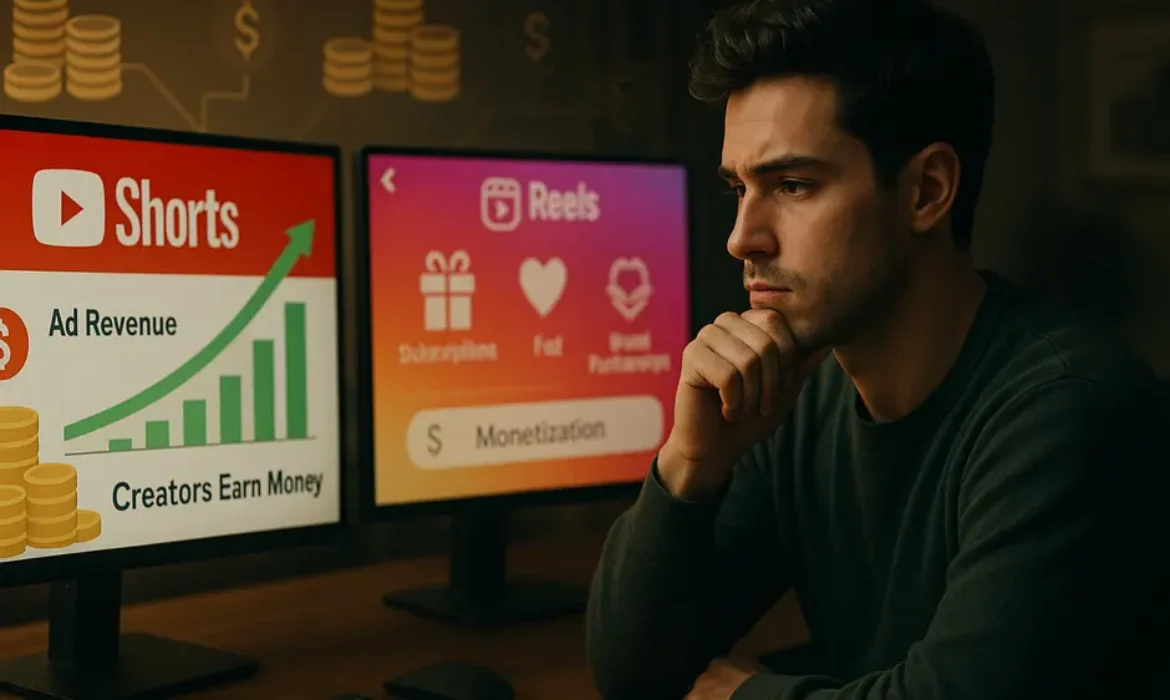
Why Instagram Reels Usually Pay Less Than YouTube Shorts
Estimated reading time: 13 minutes
1. The Creator Pay Gap Nobody Talks About Honestly
If you have spent any time creating short-form video content and trying to monetize it, you have probably noticed something frustrating: the numbers just do not add up equally across platforms. A Reel that pulls in 500,000 views on Instagram often generates a fraction of what a similarly performing YouTube Short would earn. That is not a coincidence. It is the result of fundamentally different business philosophies, advertising infrastructures, and monetization architectures that each platform has built over the years.
This piece breaks down exactly why Instagram Reels pay less than YouTube Shorts in most cases, what drives those differences at a structural level, and what you can realistically do about it as a creator trying to build sustainable income from short-form video.
The comparison matters because short-form video is not a side hustle anymore. According to Statista, short-form video content consumption has grown exponentially since 2020, and creators are betting their careers on platforms that may or may not be paying them fairly. Understanding the monetization mechanics behind each platform is not just interesting trivia. It is essential business intelligence.
2. How YouTube Shorts Actually Makes Money for Creators
YouTube’s approach to monetizing Shorts went through a significant evolution before landing where it is today. In the early days, Shorts were essentially a traffic driver with no direct revenue mechanism. YouTube recognized that creators were not going to prioritize the format if there was nothing in it for them financially, so in February 2023, they overhauled the system entirely.
The YouTube Partner Program and Shorts Revenue Sharing
The biggest shift was integrating Shorts into the YouTube Partner Program (YPP). Previously, only long-form videos qualified for ad revenue sharing. Now, Shorts creators who meet the eligibility threshold — 500 subscribers and 3,000 watch hours on long-form content, or 1,000 subscribers and 10 million Shorts views in 90 days — can participate in a shared revenue model.
Here is how the YouTube Shorts revenue model actually works:
- Ads run between Shorts in the Shorts Feed
- All ad revenue from those ads gets pooled
- Creators receive a share of that pool based on their proportional contribution to total Shorts views
- YouTube keeps 55% and creators receive 45% of their allocated pool share
That 45% figure is actually consistent with what YouTube pays for standard long-form content, which signals that the company views Shorts as a legitimate revenue channel rather than an afterthought.
Why the Pool Model Works Better Than It Sounds
The pooled revenue model gets criticized, but it has a crucial advantage: it is systematic, transparent, and tied directly to advertising revenue that actually exists. Advertisers bid for space between Shorts. That money is real, it flows into the pool, and creators get a defined cut.
YouTube’s long-standing relationship with advertisers — built over nearly two decades — means that pool is not empty. Brands that run Google Ads campaigns frequently extend their budgets to YouTube placements, and Google’s advertising infrastructure through Google Ads is one of the most sophisticated ad delivery systems in the world.
3. How Instagram Reels Monetization Really Works
Instagram’s monetization story for Reels is considerably messier. The platform has cycled through multiple programs, adjusted payouts unpredictably, and ultimately left many creators feeling like they were chasing a moving target.
The Reels Play Bonus Program
Meta launched the Instagram Reels Play Bonus in 2021 as an invitation-only program where creators could earn money based on their Reels performance. The structure was straightforward: hit certain play milestones within a defined period and receive a bonus payment.
The problems with this model showed up quickly:
- It was not universally available — only selected creators received invitations
- Payout thresholds and amounts varied without clear public documentation
- Meta began winding down the program in parts of the world starting in 2023
- The bonuses were never tied to advertising revenue in a transparent way
By early 2023, Meta had officially ended the Reels Play Bonus program in the United States and several other markets. Some creators went from earning a few thousand dollars monthly to zero overnight. That kind of instability is not a minor inconvenience — it is a structural problem with how Instagram approaches creator compensation.
What Instagram Offers Now
As of the current landscape, Instagram’s direct monetization options for Reels creators are limited compared to YouTube. The primary options include:
- Gifts and Stars: Fans can send virtual gifts during live content or on Reels, which creators can convert to real money
- Subscriptions: Creators can offer paid subscriber tiers for exclusive content
- Brand partnerships: Instagram facilitates branded content deals through Creator Marketplace
- Shopping integrations: Creators can tag products in Reels and earn affiliate-style commissions
What is conspicuously absent is a systematic, ad-revenue-sharing model for Reels comparable to what YouTube has built. Instagram runs ads between Reels — those mid-feed ads are very much real — but the revenue from those ads does not flow back to creators in any standardized way.
4. The Core Structural Differences That Drive the Pay Gap
Understanding why Instagram Reels earnings fall behind YouTube Shorts payouts requires looking at the infrastructure behind each platform rather than just the surface-level programs.
Ownership of the Ad Ecosystem
YouTube is owned by Google, which controls one of the largest digital advertising ecosystems on earth. When a brand runs ads on YouTube, the transaction runs through Google’s ad infrastructure, and Google has both the incentive and the mechanism to share that revenue with creators because creators are the product — they attract the viewers who watch the ads.
Meta operates its own advertising platform, which is also extremely powerful. However, Instagram was built primarily as a social discovery and connection platform. Advertising revenue on Instagram has historically been funneled back into Meta’s overall business rather than being redistributed to content creators as a structural policy.
The Philosophy of Creator Compensation
YouTube’s entire business model has revolved around creator incentives since the Partner Program launched in 2007. The platform explicitly aligned creator success with platform success — more creator investment meant better content, better content meant more viewers, more viewers meant more ad revenue. It created a genuine feedback loop.
Instagram built its value proposition differently. The platform grew on user-generated content that was freely given. Celebrity culture, social networking, and aspirational lifestyle content drove growth without requiring direct payments to creators. That philosophy has proven remarkably difficult to reverse even as the creator economy has matured.
Data Transparency
YouTube provides creators with detailed analytics on revenue per thousand views (RPM), cost per mille (CPM) data, and clear breakdowns of how earnings are calculated. This transparency is not just user-friendly — it is a trust signal that encourages creators to invest more in the platform.
Instagram’s payout system has historically been opaque. Creators in the Reels Play Bonus program often could not determine exactly why they received specific amounts or how their performance translated to dollars. That opacity erodes trust and makes it harder for creators to optimize their content strategy around revenue.
5. Revenue Per View: A Direct Comparison
Putting concrete numbers to the comparison is difficult because both platforms have variable rates depending on niche, audience geography, engagement quality, and timing. However, industry data and creator reports paint a reasonably clear picture.
| Metric | YouTube Shorts | Instagram Reels |
|---|---|---|
| Revenue model | Ad revenue sharing (pool) | Bonuses (discontinued in many markets), Stars, affiliate |
| Creator revenue share | 45% of allocated pool | No standardized percentage |
| RPM range (estimated) | $0.03 – $0.07 per view | $0.01 – $0.02 per view (bonus era, now largely ended) |
| Program availability | Global, via YPP | Limited, invitation-based (or discontinued) |
| Transparency | High (detailed analytics) | Low to moderate |
| Minimum eligibility | 500 subs + 3K watch hours OR 1K subs + 10M Shorts views | Invitation-only (where available) |
| Payment consistency | Monthly, predictable | Irregular, program-dependent |
These figures come from aggregated creator reports shared across forums like Reddit’s r/NewTubers and r/InstagramMarketing, as well as creator economy research. The ranges are indicative rather than fixed because too many variables affect individual creator earnings to give precise universal numbers.
The core conclusion from this data is consistent: YouTube Shorts earnings per view tend to be higher and more reliable than what Instagram Reels have offered. And critically, YouTube’s model scales — the more views you generate, the more money you earn in a predictable way. Instagram’s bonus model never worked that cleanly even when it existed.
6. Why YouTube’s Ad Model Is Fundamentally More Creator-Friendly
The ad revenue sharing model is not just about the numbers. It is about alignment of interests.
When YouTube shares ad revenue with creators, both parties benefit from the same actions: creating compelling content, building a loyal audience, and keeping viewers engaged long enough to see ads. The creator and the platform want the same thing.
Instagram’s approach has historically created a more complicated dynamic. The platform benefits from Reels content because it keeps users in the app, which drives ad impressions across the entire platform. But those impressions generate revenue for Meta broadly, not specifically for the creator whose content generated the engagement. The creator gets exposure. Meta gets the money.
This is not an accusation of bad faith — it is a description of how the business model was constructed. And it explains why creator complaints about Instagram monetization are so persistent: the fundamental incentive structure was never fully aligned.
Google’s Advertising Infrastructure Advantage
Google processes an estimated 224 billion search queries per day, and its advertising reach through Google Ads, Display Network, and YouTube is genuinely unmatched. When advertisers allocate budgets to YouTube, they are often working within broader Google campaign structures that have high CPMs attached because the targeting is precise and the conversion data is rich.
Instagram’s CPMs are competitive, but the ad inventory on Reels specifically has not historically commanded the same rates as YouTube’s video ad formats, particularly because Reels ads are newer and less proven to advertisers in terms of conversion data.
7. Instagram’s Monetization History and Why It Keeps Falling Short
Meta’s relationship with creator monetization has been characterized by ambition followed by retreat. The company announced ambitious creator fund programs — not just for Instagram but for Facebook as well — during the height of the TikTok competition in 2021 and 2022. The goal was clear: attract creators away from TikTok and YouTube by offering financial incentives.
The execution, however, consistently disappointed.
The Pattern of Promises and Pullbacks
Facebook Watch had similar bonus structures that were wound down. IGTV, Instagram’s long-form video experiment, was promoted heavily and then essentially abandoned. The Reels Play Bonus followed the same arc. Meta committed billions to creator monetization programs and then scaled them back as competitive pressure eased and the balance sheets needed tightening.
This pattern has real consequences. Creators who built content strategies around Instagram monetization programs were left scrambling each time a program changed or ended. Compare that to YouTube’s Partner Program, which has run continuously since 2007 and has become more creator-favorable over time rather than less.
The creator economy is now estimated to be worth over $250 billion according to Goldman Sachs research, and creators increasingly evaluate platforms based on long-term financial reliability rather than just reach potential. Instagram’s track record on reliability has been a liability.
8. Platform Incentives: Who Are They Really Serving?
One of the most honest ways to evaluate any platform’s monetization offering is to ask a simple question: what does this platform actually need from me?
YouTube needs creators to keep producing quality content because content is the product. Without creators, there is nothing for viewers to watch, no reason for advertisers to buy, and no business. This existential dependency creates a genuine motivation to treat creators well financially.
Instagram needs content, but it has a much larger and more varied inventory of that content. Personal posts, Stories, professional brand accounts, influencer content, and user-generated posts all feed the algorithm. Reels creators are valuable but not irreplaceable in the same way that a major YouTube creator is essentially irreplaceable on their platform.
This dynamic shifts the leverage. YouTube has stronger incentives to keep creators financially happy. Instagram has more flexibility to offer less and still retain content because there are more content types filling the gap.
TikTok’s Creator Fund and What It Reveals
It is worth noting that TikTok’s Creator Fund had similar structural problems to Instagram’s bonus model. The fund was a fixed pool of money divided among all participating creators, which meant that as more creators joined, individual payouts shrank. TikTok eventually replaced it with the Creativity Program Beta, which offered better rates — but the initial Creator Fund experience damaged creator trust in ways that are still felt.
The lesson across platforms is that fixed bonus pools disconnected from actual advertising revenue tend to underperform and eventually get discontinued. YouTube’s ad revenue sharing model, imperfect as it is, has outlasted every alternative because it is tied to real money that scales with real performance.
9. What Smart Creators Are Actually Doing in 2024 and Beyond
Understanding the pay disparity between Instagram Reels and YouTube Shorts is useful. Knowing what to do about it is more useful.
Use Instagram for Discovery, YouTube for Revenue
Many of the most financially successful short-form creators treat Instagram Reels as a top-of-funnel awareness channel and YouTube Shorts as both an awareness and revenue channel. They post consistent Reels to grow their following and drive brand deal opportunities, while simultaneously publishing on YouTube where they can earn directly from the platform.
This dual-platform strategy acknowledges that Instagram’s reach is genuinely valuable — it just should not be mistaken for a direct revenue source in the way YouTube can be.
Build Your Monetization Off-Platform
Platform dependency is a risk regardless of which platform you use. Creators who build email lists, Patreon communities, course businesses, or product lines are effectively hedging against exactly the kind of platform policy changes that wiped out income for Instagram creators when the Reels bonus ended.
Direct audience relationships — email, SMS, owned platforms — provide income stability that no social media platform can match because they cannot be taken away by an algorithm change or program cancellation.
Optimize for YouTube Shorts RPM by Niche
Not all Shorts niches pay equally. Finance, technology, business, and legal content tend to command higher CPMs because advertisers in those categories bid aggressively. A Short about personal finance reaching 500,000 views will generate meaningfully more revenue than a comedy Short reaching the same number because the ads showing to those viewers are worth more.
If maximizing YouTube Shorts earnings is the goal, intentional niche selection matters as much as view counts.
Leverage Instagram for Brand Deal Rates
Despite lower direct monetization, Instagram’s brand deal market remains strong. Advertisers pay premium rates for sponsored Reels because Instagram’s visual format and demographic data make it attractive for product placements in lifestyle, fashion, beauty, fitness, and food categories. A creator might earn $50 directly from Instagram for a million Reels views but earn $5,000 from a single sponsored Reel to the same audience.
The platform math changes entirely when brand partnerships are factored in.
10. Key Takeaways
-
- YouTube Shorts operates on a structured ad revenue sharing model that distributes 45% of pooled advertising revenue to creators, giving it a transparent and scalable payout system
- Instagram Reels direct monetization is largely bonus-based and has been scaled back significantly in most markets, with no standardized ad revenue sharing for Reels creators
- The revenue per view gap between the two platforms is real, with YouTube Shorts generally outperforming Instagram Reels on direct creator income per thousand views
- YouTube’s deeper integration with Google’s advertising infrastructure gives it a structural advantage in generating high-CPM ad revenue to share with creators
- Instagram’s historical pattern of launching and then winding down monetization programs has created a trust deficit among creators that affects how seriously they invest in the platform for income purposes
- Smart creators use both platforms strategically — Instagram for reach and brand deals, YouTube for direct revenue — rather than relying exclusively on either
- Off-platform monetization remains the most stable income strategy regardless of where a creator’s audience primarily lives
11. FAQs
Q1: How much do YouTube Shorts actually pay per 1,000 views?
The honest answer is that it varies considerably depending on niche, audience location, time of year, and engagement quality. Based on creator-reported data and industry estimates, YouTube Shorts RPM generally falls in the range of $0.03 to $0.07 per view, which translates to roughly $3 to $7 per 1,000 views. Finance, legal, and technology content tends to sit at the higher end of that range. Entertainment and comedy content often lands at the lower end. YouTube’s own analytics will show you your specific RPM once you are monetized, which provides the most accurate picture for your channel specifically.
Q2: Does Instagram still pay creators for Reels views in 2024?
Instagram discontinued the Reels Play Bonus program in the United States and several other major markets starting in 2023. In some regions, scaled-back bonus programs may still exist, but they are not universally available or reliably documented. Instagram’s current direct monetization options center around Gifts, Subscriptions, and Shopping integrations rather than a view-based payment model. For most creators in most markets, Instagram does not offer a direct pay-per-view arrangement for Reels comparable to YouTube’s system.
Q3: Why does YouTube pay more than Instagram if both platforms run ads?
Both platforms run ads, but there is a critical structural difference: YouTube shares the revenue from those ads with creators, while Instagram historically has not done so for Reels content in a standardized way. YouTube’s entire business model is built on the creator-advertiser-viewer triangle, and the 45% revenue share to creators is baked into that model. Instagram’s ad revenue has traditionally flowed to Meta’s business broadly rather than being redistributed to the specific creators whose content generated the engagement. The difference is not about which platform charges more for ads — it is about who receives the resulting revenue.
Q4: Is it worth posting on both YouTube Shorts and Instagram Reels?
Yes, and most experienced creators recommend a multi-platform strategy precisely because the two platforms serve different purposes well. YouTube Shorts can generate direct monthly income through revenue sharing while also feeding viewers into your long-form content library. Instagram Reels offers strong discovery potential, access to Instagram’s shopping and brand partnership ecosystem, and an audience that tends to be receptive to direct product recommendations. The content is often repurposable between platforms with minor adjustments, so the marginal effort of posting on both is relatively low compared to the combined benefit.
Q5: What is the minimum requirement to monetize YouTube Shorts?
As of the current YouTube Partner Program structure, creators can qualify for monetization through one of two pathways. The first requires 1,000 subscribers and 4,000 valid public watch hours on long-form content in the past 12 months. The second, introduced specifically to accommodate Shorts creators, requires 1,000 subscribers and 10 million Shorts views within 90 days. Meeting either threshold qualifies a creator to apply for the YPP, which includes access to the Shorts revenue sharing program alongside standard long-form monetization options.
Q6: Can creators earn more from Instagram Reels through brand deals than from YouTube Shorts through ad revenue?
Absolutely, and for many mid-tier creators this is actually the reality. A creator with 200,000 Instagram followers in a lifestyle niche might earn $2,000 to $5,000 per sponsored Reel from brand partnerships while earning relatively little directly from Instagram itself. The same creator on YouTube Shorts might earn $100 to $500 monthly from ad revenue at similar view volumes. The total earnings comparison depends heavily on how actively the creator pursues and lands brand deals, which is itself a skill and a business development effort. The platforms are not apples-to-apples when brand deals are factored into the equation.
Q7: Will Instagram ever introduce a proper ad revenue sharing model for Reels?
Meta has signaled interest in improving creator monetization programs, but they have not announced a YouTube-style ad revenue sharing model for Reels as of this writing. The challenge for Meta is structural: shifting to a revenue-sharing model would require routing a significant portion of Instagram’s advertising income directly to creators rather than into Meta’s consolidated revenue. Given Meta’s ongoing investment in AI infrastructure and the competitive pressure from multiple directions, predicting when or whether this change happens is speculative. What creators can reasonably expect is continued incremental improvements to subscription and gifting tools rather than a fundamental overhaul of the advertising revenue distribution model.
12. Final Thoughts
The pay disparity between Instagram Reels and YouTube Shorts is not a mystery once you understand the underlying mechanics. YouTube built a business model that aligned creator success with platform success from the beginning, and that alignment has produced a monetization infrastructure that genuinely rewards consistent creators. Instagram built a social platform first and has been retrofitting creator monetization onto that foundation ever since, with results that have been inconsistent at best.
None of this means Instagram is a bad platform to build on. Its reach, its cultural influence, and its value as a brand partnership channel are real and significant. But treating it as a primary direct income source in the same way YouTube can be used is a mistake that has cost creators real money.
The smartest move is to understand what each platform does well, use them accordingly, and build as much of your monetization infrastructure off-platform as possible. Platforms change their rules. Your email list and your product business do not.
For further reading on the creator economy and platform monetization trends, the Creator Economy Report by Linktree and Goldman Sachs’ analysis of the creator economy provide useful context on where the industry is heading.