
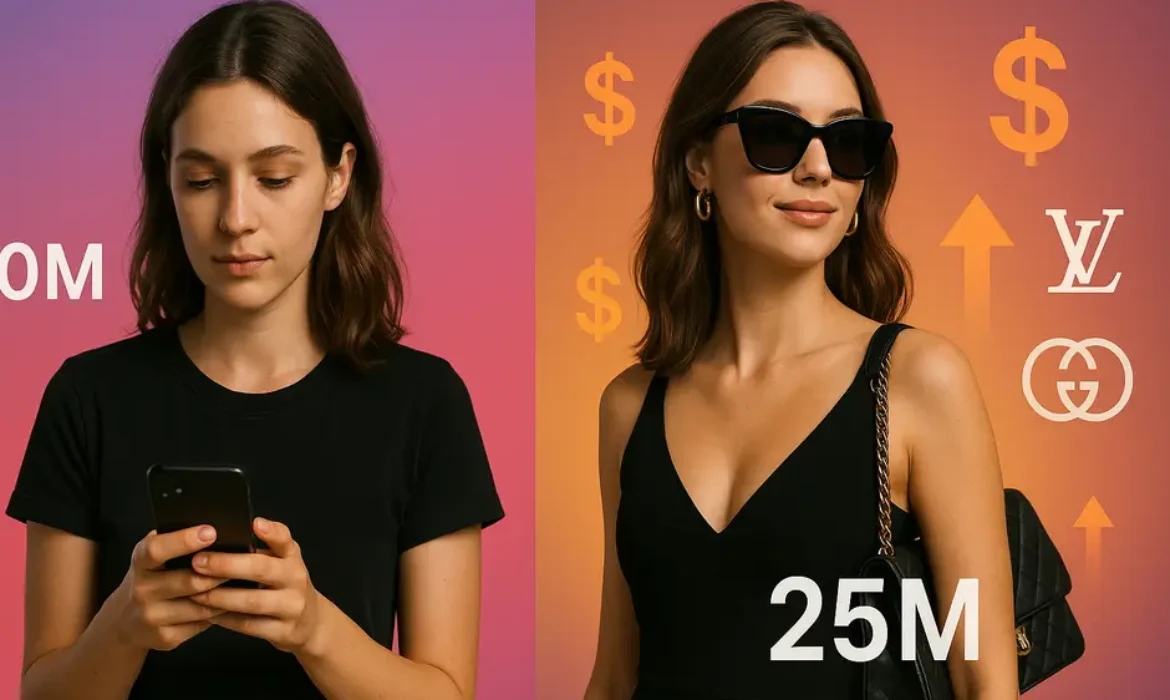
10 Million vs 25 Million Followers on Instagram: How Creator Income Changes
Estimated reading time: 16 minutes
Key Takeaways
-
- An Instagram influencer with 10 million followers typically earns between $10,000 and $80,000 per sponsored post, depending on niche, engagement rate, and contract scope
- Reaching 25 million followers does not simply double income — it can multiply earning potential by 3x to 10x due to premium brand positioning, equity deals, and category exclusivity
- Engagement rate remains the single most scrutinized metric by brand marketing teams when negotiating Instagram endorsement deals, often outweighing raw follower count
- Top-tier creators at both levels generate the majority of their income outside of per-post sponsorships — through licensing, merchandise, digital products, and long-term brand partnerships
- Niche alignment, audience demographics, and platform diversification determine whether a 10 million follower creator out-earns someone with 25 million in a less monetizable vertical
Why Follower Count Still Matters — But Not in the Way You Think
There is a persistent myth in influencer marketing circles that follower count is becoming irrelevant. Engagement is everything, the argument goes. A micro-influencer with 50,000 hyper-loyal followers can outperform a celebrity account with millions of passive scrollers.
That is partially true — and completely misleading at the same time.
When you cross the 10 million follower threshold on Instagram, something structural changes in how brands, publicists, and media companies perceive and price your value. You are no longer operating in the influencer economy. You have entered the celebrity economy. The rules, the deal structures, and the income potential shift in ways that raw engagement metrics alone cannot explain.
And then there is the jump from 10 million to 25 million. That leap is not linear. It is exponential — not just in income, but in leverage, access, and the type of deals that become available to you.
This piece unpacks exactly what that income looks like at both stages, where the money actually comes from, and what separates creators who maximize those numbers from those who leave significant revenue on the table.
The Real Economics Behind Instagram Creator Income
Most people outside the industry assume Instagram pays creators directly and generously based on reach. The reality is more nuanced.
Instagram’s native monetization tools — Reels bonuses, subscriptions, Badges in Live — exist, but for creators at the 10 million and 25 million follower level, these features represent a small fraction of total income. According to reporting from Business Insider, even top-tier creators describe platform-native payouts as supplemental at best.
The real money flows through four primary channels:
-
-
- Brand partnerships and sponsored content — single posts, story packages, Reels campaigns, and multi-platform deals
- Long-term ambassadorships — category exclusivity contracts that often last 6–24 months
- Licensing and intellectual property — using a creator’s image, likeness, or content in advertising campaigns
- Owned business ventures — product lines, courses, apps, and media companies
-
Understanding this ecosystem is critical before analyzing what income actually looks like at 10 million versus 25 million followers.
What an Instagram Influencer with 10 Million Followers Actually Earns
Reaching 10 million followers on Instagram places a creator firmly in the “mega influencer” category — a tier that most marketing professionals define as anyone above 1 million followers, though the 10 million mark is where the economics genuinely shift.
Sponsored Post Rates at 10 Million Followers
Industry benchmarks consistently place single-post sponsored rates for a 10 million follower account between $10,000 and $80,000. The wide range reflects variables we will cover shortly, but the central figure for most lifestyle, fitness, and beauty creators in this tier lands around $20,000 to $40,000 per post.
A standard formula used by many talent agencies — often called the “penny per follower” rule — would suggest $100,000 per post at 10 million followers. In practice, this rarely holds because engagement rates typically decline as follower counts grow, and brands price based on expected outcomes rather than theoretical reach.
Here is what the rate landscape actually looks like at 10 million followers across content types:
| Content Format | Estimated Rate Range |
|---|---|
| Single Feed Post | $10,000 – $50,000 |
| Instagram Reel | $15,000 – $80,000 |
| Stories Package (5–7 slides) | $8,000 – $30,000 |
| Full Campaign (Feed + Reel + Stories) | $40,000 – $150,000 |
| Long-Term Ambassadorship (per month) | $30,000 – $100,000 |
These figures align with data from influencer marketing platforms like Later and agency rate cards published by firms such as Viral Nation and Influencer Marketing Hub.
Annual Income Potential at 10 Million Followers
If a creator at 10 million followers executes roughly two to three paid brand deals per month — a realistic volume that avoids audience fatigue — their annual sponsorship income lands between $480,000 and $1.8 million. Creators who add ambassadorships, licensing agreements, and their own product lines regularly push past $2 million to $5 million annually.
The highest earners in this tier are those who have built genuine authority in a monetizable niche. A personal finance creator with 10 million followers can command premium rates because financial services brands — banks, fintech companies, credit card issuers — have large advertising budgets and willingness to pay for qualified leads. A general lifestyle creator with the same audience size might earn half as much per post.
What Brands Are Actually Paying For
At this level, brands are not simply buying reach. They are buying cultural credibility. A creator with 10 million followers who has cultivated a trusted relationship with their audience becomes a shortcut to consumer confidence — something that traditional advertising rarely delivers as efficiently. This is why 10 million instagram followers income discussions often focus less on CPM (cost per thousand impressions) and more on brand lift, purchase intent, and social proof value.
What Changes at 25 Million Instagram Followers
The distance between 10 million and 25 million followers is not just quantitative. It represents a qualitative shift in market positioning that most creators underestimate.
At 25 million followers, a creator enters a rarefied group. As of recent platform data, fewer than 2,000 accounts globally have crossed that threshold organically in non-entertainment categories. In entertainment and sports, the names at this level are recognizable to virtually anyone: Cristiano Ronaldo, Kylie Jenner, Selena Gomez. But there is a growing class of native content creators — people who built their audiences post-by-post rather than through offline fame — who are reaching this tier and commanding comparable deal structures.
Sponsored Post Rates at 25 Million Followers
Rates at 25 million followers typically start where the 10 million tier peaks. The baseline for a single sponsored post is rarely below $50,000, and mid-to-high-tier creators in desirable categories regularly command $150,000 to $500,000 per post.
| Content Format | Estimated Rate Range |
|---|---|
| Single Feed Post | $50,000 – $250,000 |
| Instagram Reel | $80,000 – $500,000 |
| Stories Package (5–7 slides) | $30,000 – $100,000 |
| Full Campaign (Feed + Reel + Stories) | $150,000 – $800,000 |
| Long-Term Ambassadorship (per month) | $100,000 – $500,000 |
| Equity/Co-Creation Deal | Variable — often 7 figures annually |
The introduction of equity and co-creation deals at this tier fundamentally changes the income ceiling. Brands at the 25 million level are not just paying for posts — they are paying for category ownership.
The Premium Multiplier Effect
Something that industry insiders call the “premium multiplier” kicks in at the 25 million threshold. Brands competing in the same category — two competing skincare brands, two rival sneaker companies — actively bid against each other for exclusivity. When exclusivity enters the negotiation, rates can jump 2x to 5x above standard sponsorship pricing.
This dynamic does not meaningfully exist at 10 million followers. At that level, brands might request a 30-day exclusivity window at a modest premium. At 25 million followers, brands will pay for six months to two years of category exclusivity because the cost of a competitor owning that creator relationship is too damaging to ignore.
Annual Income Potential at 25 Million Followers
Conservative estimates for a creator with 25 million engaged followers, executing a disciplined and selective partnership strategy, put annual income between $5 million and $20 million. Creators who layer in owned businesses, licensing deals, and equity partnerships regularly exceed $20 million annually.
The 25 million instagram followers income question cannot be answered with a single number because the structural income sources available at this level are qualitatively different. You are not calculating posts times rate. You are calculating brand equity, licensing royalties, product line revenue, media deals, and speaking fees simultaneously.
Instagram Sponsorship Rates: The Full Breakdown by Tier
| Follower Tier | Category Label | Typical Post Rate |
|---|---|---|
| 10,000 – 100,000 | Micro Influencer | $100 – $2,500 |
| 100,000 – 500,000 | Mid-Tier Influencer | $2,500 – $15,000 |
| 500,000 – 1,000,000 | Macro Influencer | $10,000 – $30,000 |
| 1,000,000 – 10,000,000 | Mega Influencer | $15,000 – $80,000 |
| 10,000,000 – 25,000,000 | Celebrity Influencer | $50,000 – $500,000 |
| 25,000,000+ | A-List Celebrity Tier | $150,000 – $1,000,000+ |
These ranges are derived from published rate benchmarks across Influencer Marketing Hub, Hootsuite’s influencer marketing data, and agency-disclosed rate cards. Actual rates depend heavily on niche, engagement rate, audience demographics, and content quality.
Beyond Brand Deals: How Mega Influencers Diversify Revenue
The most financially sophisticated creators at both the 10 million and 25 million follower levels share one thing in common: they do not rely on sponsored content as their primary income source.
Brand deals are unpredictable. Marketing budgets shift. Viral moments fade. A creator who builds their entire income architecture around per-post fees is one brand budget cycle away from significant income volatility.
Here is how the top earners at these tiers actually build sustainable wealth:
Merchandise and Product Lines
Physical products co-created with or entirely owned by the creator have become one of the most reliable income streams at the mega influencer level. The margin structure — especially with print-on-demand or direct-to-consumer models — allows creators to capture revenue that would otherwise go to brand partners.
Creators like Emma Chamberlain (Chamberlain Coffee) and Addison Rae demonstrate how a strong Instagram following can launch genuine consumer brands. At 10 million and 25 million followers, the built-in customer acquisition advantage is massive.
Digital Products and Education
Online courses, presets, membership communities, and exclusive content subscriptions have become significant income contributors for creators in knowledge-based niches. A fitness creator with 10 million followers who sells a $97 workout program to just 0.1% of their audience generates $970,000 in a single launch. At 25 million followers, that same conversion rate yields nearly $2.5 million.
Media and Content Licensing
Brands frequently want to amplify sponsored content through paid media — running a creator’s Reel as a paid advertisement, using their image in out-of-home advertising, or featuring them in television spots. These licensing agreements add significant income on top of original creation fees. Industry norms price media usage rights at 20% to 100% of the original content creation fee, depending on exclusivity, duration, and channel scope.
Speaking, Appearances, and Events
At 25 million followers, a creator’s appearance at a brand activation or trade show event commands between $50,000 and $500,000 per appearance. This is particularly true in beauty, fitness, and lifestyle categories where live brand experiences carry enormous marketing value.
The Hidden Variables That Determine Celebrity Instagram Income
Two creators with identical follower counts can have dramatically different income profiles. These are the factors that explain why:
Engagement Rate
An engagement rate above 2% at 10 million followers is considered strong; above 3.5% is exceptional. Engagement rate directly influences what brands are willing to pay because it correlates with audience activation. A creator with 10 million followers and a 4% engagement rate can often charge more per post than someone with 15 million and a 0.8% rate.
Audience Demographics
A U.S.-based audience aged 25–44 with household incomes above $75,000 is significantly more valuable to most advertisers than a globally diffuse audience of the same size. Brands in beauty, finance, travel, and luxury goods will pay substantial premiums for access to high-value demographic clusters.
Niche Authority
Niche authority creates pricing power. A creator who owns the conversation in a specific vertical — say, sustainable fashion, HIIT training, or real estate investing — commands rates that reflect their category position rather than just their audience size. This is why instagram celebrity income comparisons between different niches can look dramatically different even at identical follower counts.
Content Quality and Production Value
Premium content requires premium production. At the 10 million and 25 million follower level, brands expect professional-grade deliverables. Creators who invest in quality production signal to brand partners that their sponsored content will perform — and that justifies higher rates.
Posting Frequency and Audience Trust
Creators who post less frequently, or who are selective about the brands they partner with, often command higher per-post rates because their audience trust is higher and their feed is less saturated with sponsored content. Scarcity is a genuine pricing lever at this tier.
Creator Growth Strategy: What the Jump from 10M to 25M Actually Requires
The strategic question for many creators sitting at the 10 million mark is not whether the income jump at 25 million is real — it clearly is — but how to get there without diluting the engagement rate that makes their audience valuable in the first place.
Growing from 10 million to 25 million requires a deliberate content strategy rather than a volume strategy. Algorithm dynamics on Instagram, as documented by Meta’s own creator guidance, favor content that generates saves, shares, and extended watch time over raw posting frequency.
Platform Diversification as a Growth Accelerator
Creators who grow fastest from 10M to 25M typically leverage cross-platform presence — particularly YouTube, TikTok, and podcasting — to funnel new audiences back to Instagram. YouTube’s long-form search traffic, in particular, creates durable discovery that Instagram’s algorithm alone cannot replicate.
Collaborations and Strategic Visibility
At the 10 million follower level, access to A-list collaborations opens up. Strategic creator-to-creator partnerships — particularly with accounts in adjacent but non-competing niches — can accelerate audience growth significantly. The key is choosing collaborators whose audiences have genuine overlap with your content value proposition.
Content Pillars and Topic Authority
Instagram’s content recommendation systems increasingly reward accounts that demonstrate clear topic authority rather than broad lifestyle content. Creators who define three to five content pillars and execute them consistently tend to see stronger algorithmic distribution, which compounds follower growth over time.
FAQs
Q1: How much does an Instagram influencer with 10 million followers make per year?
Annual income for a creator at 10 million followers varies widely, but a realistic range for someone actively monetizing through brand partnerships, ambassadorships, and owned products sits between $1 million and $5 million per year. Creators in high-value niches with strong engagement rates and diversified income streams can exceed $10 million annually. Base sponsorship income alone — assuming two to three deals per month at average rates — typically generates $480,000 to $1.8 million.
Q2: Is 25 million Instagram followers income significantly higher than at 10 million?
Yes, and often more than proportionally so. The jump from 10 million to 25 million followers does not just scale existing income — it unlocks deal structures that are not available at the lower tier. Category exclusivity premiums, equity partnerships, licensing deals, and media appearance fees all expand substantially. Creators at 25 million followers routinely earn three to ten times what they made at 10 million, even accounting for the follower count difference.
Q3: What is the average Instagram sponsorship rate per post for mega influencers?
For mega influencers broadly defined (1M to 10M followers), average per-post rates range from $15,000 to $80,000. At the 10 million follower level, typical rates for a single feed post fall between $20,000 and $50,000, while Reels often command more. Full campaign packages — combining feed posts, Reels, and Stories — regularly reach $100,000 to $300,000 at the 10 million tier.
Q4: Do engagement rates matter more than follower count for Instagram brand deals?
Both matter, but brands weight them differently depending on their campaign objective. For awareness and reach campaigns, raw follower count carries more weight. For performance campaigns oriented around clicks, conversions, or sales, engagement rate and audience quality take precedence. At the 10 million and 25 million follower level, brands typically require both strong reach and meaningful engagement — neither alone is sufficient to command premium rates.
Q5: How do creators with 25 million followers structure their income differently from those at 10 million?
At 25 million followers, the income mix shifts toward long-term contracts, equity deals, licensing fees, and owned business revenue. While a 10 million follower creator might derive 60–70% of income from individual sponsored posts, a creator at 25 million often derives the majority from multi-year brand partnerships, product line royalties, and appearance fees. This shift represents a move from transactional income to structural income — which is both more stable and significantly higher in total value.
Q6: What niches command the highest Instagram endorsement deals at the mega influencer level?
Personal finance and fintech, luxury and high-end fashion, health and wellness technology, beauty and skincare, and real estate investment content consistently command the highest per-post rates at the mega influencer level. This reflects the customer lifetime value and transaction sizes in those industries. A fintech brand acquiring a high-net-worth customer through an influencer post may generate thousands of dollars in revenue per conversion, justifying premium sponsorship investment.
Q7: Can a creator with 10 million followers earn more than one with 25 million?
Yes, and it happens more often than people assume. Niche authority, audience demographics, engagement rate, and content quality can all allow a smaller account to outperform a larger one in specific commercial contexts. A 10 million follower creator in personal finance targeting U.S. professionals aged 30–50 may command higher per-post rates than a 25 million follower lifestyle creator with a globally diffuse, younger audience. Follower count establishes a ceiling; everything else determines where within that ceiling you operate.
Conclusion
The income gap between 10 million and 25 million Instagram followers is real, significant, and compounding. But the more important insight is not the number itself — it is understanding what the number unlocks.
At 10 million followers, you have cleared a critical threshold. You have moved into the category where brand marketing teams take you seriously at a budget level that changes careers. You have access to deals, collaborators, and platforms that simply were not available at lower tiers. The annual income potential — ranging from $1 million to $5 million for a well-monetized creator — is genuinely life-altering.
At 25 million followers, the structural nature of how you earn changes. You are no longer just a media channel. You are a brand asset. The deals on the table involve equity, long-term licensing, product co-creation, and category ownership. The income ceiling — notional as ceilings always are — expands dramatically. Creators at this level who build intelligently around their audience do not just earn well; they build lasting financial structures that function independently of any single brand deal or algorithm change.
The path from 10 million to 25 million is not paved with more posts. It is built on sharper content strategy, stronger audience relationships, smarter business decisions, and a willingness to treat the creator career as exactly that — a career requiring the same deliberate skill-building as any other high-stakes professional pursuit.
For anyone studying the economics of Instagram creator income at scale, the lesson is consistent: follower count opens doors. What you build behind those doors determines how much you earn when they close.
Sources and contextual references: Influencer Marketing Hub, Meta Creators, Later Blog, Statista Influencer Marketing Data, Business Insider Creator Economy Coverage